


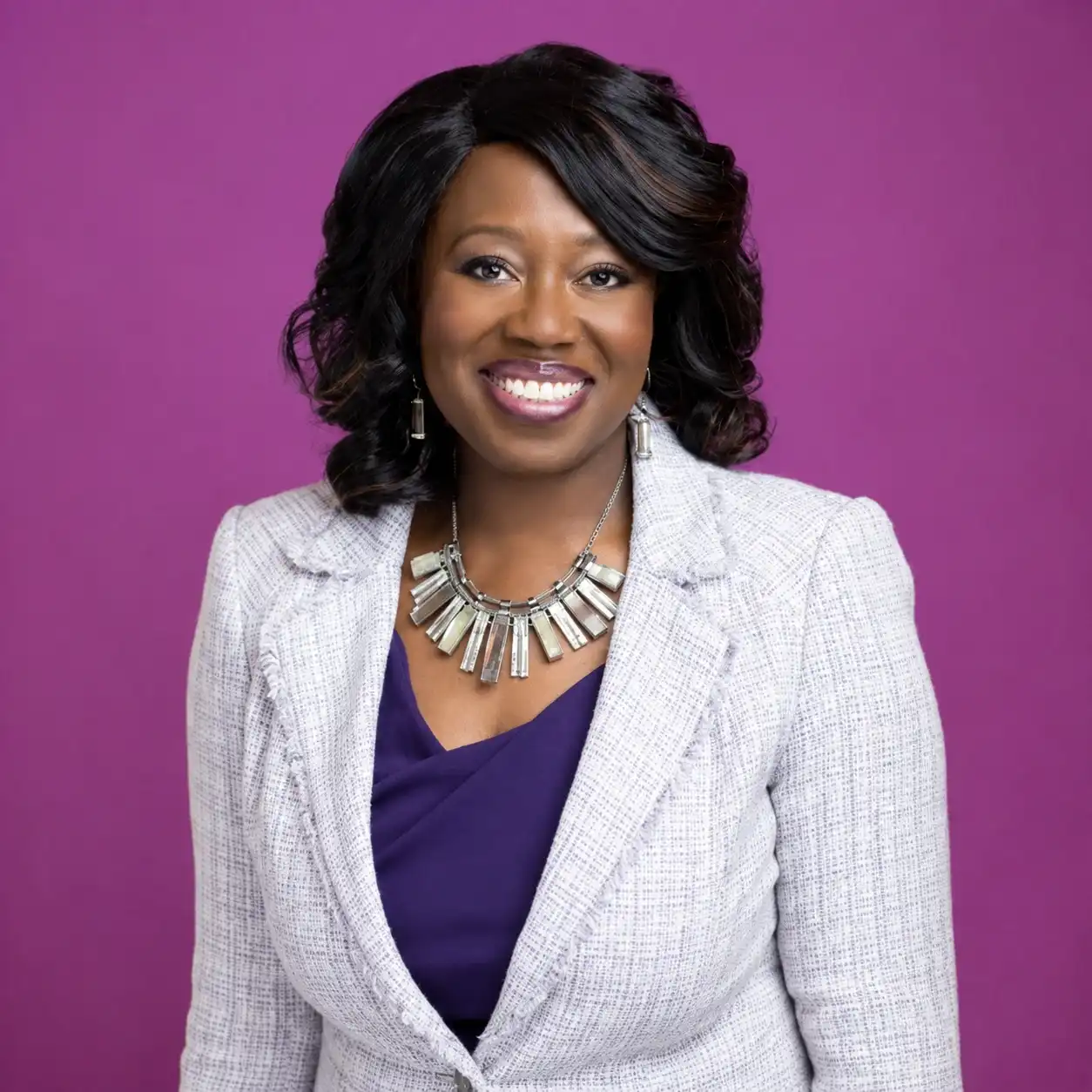



I Was Killing Myself and Still Got Laid Off
How much of yourself have you handed over to a company that could let you go tomorrow? My guest this week, Dr. Elizabeth Carter, found out in 2016. Her words, not mine: I was killing myself and still got laid off. What she took from it is the line I want tattooed on every woman listening. Always know your own personal brand, because your brand will always be with you. The company may not be.
Elizabeth was supposed to be a lawyer. That was the assignment handed to her at birth, with her brother cast as the doctor. She enrolled in pre-law, changed her major twice just to graduate on time, sat the LSAT anyway, and failed it. She calls herself a career drifter in those years. She found her actual career in a newspaper classified ad, mailed in a resume, and landed in insurance because she was good at math. Today she holds a bachelor's degree, two master's degrees, and a PhD, she is a VP of clinical strategy, execution and business operations, and she has written four books.
The part that stopped me cold is what she learned decades later, while writing her father's autobiography. Her dad had wanted to be a schoolteacher. His own mother told him he was too smart for that and demanded a doctor. He never became one, and he handed the exact same weight to Elizabeth. She spent years overachieving to repair a disappointment that was never really hers, and he never praised his kids, because his mother never praised him. Her words for it: these generational gaps sometimes impede us, because we think that is the way it is supposed to be, because that is all we know.
Her mission has a name. Break the Eight, for the share of corporate leadership roles held by African Americans, a number she notes has crept up to roughly 9%. The pipeline data backs her up and then some. McKinsey research finds Black employees make up 14% of the US workforce, 7% of managers, 5% of vice presidents, and 4% of senior vice presidents. It narrows at every single rung.
And the rung Elizabeth names on air is the very first one. The 2025 Women in the Workplace report from McKinsey and LeanIn.Org found that for every 100 men promoted to manager, 93 women get promoted, and just 60 Black women. That broken rung is now in its eleventh year. So take what she is offering. Build the brand that travels with you. Get three advocates, one inside your function, one outside it, and one senior enough to have the hard conversation on your behalf. And go with your gut, because your body tells you something is wrong long before your head will admit it. The body keeps score.
TRANSCRIPT:
Erica: Hey, girl. By now, you know I have HER Collective, my online community for ambitious women who are done doing it alone. HER Collective is for the women who are smart, capable, and driven, but they find themselves stuck on the sticky floors like self doubt, burnout, and waiting for permission that quite honestly never comes. Inside HER, you get more than motivation. You get real support, real strategies, and real momentum.
Erica: We work on things like clarifying what you want now and what's coming next, building confidence without burning yourself out, handling hard conversations, career moves, and leadership moments with clarity, and surrounding yourself with women who actually get it. This isn't about hustling harder. It's about moving intentionally with the right tools and the right people in your corner. If you're ready to stop spinning, start choosing yourself, and build a career and a life that actually feels aligned, I'd love to welcome you inside HER Collective. You can learn more and join us at www.joinhercollective.com.
Erica: Because honestly, girl, you were never meant to do this alone.
Elizabeth: I've learned to become very flexible in my life, and that always comes with age and experience. And knowing that a company is not your parachute. The company can let you go whenever they feel like it, whether you worked hard or not, because that did happen to me. I was killing myself and still got laid off. From that point in time, I said it's all about me.
Elizabeth: I will work my hardest for you as an organization, but always know my own personal brand, because my brand will always be with me. The company may not be. And that's why I love to continue to learn and grow, and that gets me into new spaces to meet new people.
Erica: And that
Elizabeth: the growth, they say the comfort zone is the danger zone, because nothing good ever happens there.
Erica: I'm your host, Erica Rooney. And today, I am here with Doctor Elizabeth Carter, who is the VP of clinical strategy, execution and business operations. Whew.
Erica: That's a mouthful. But she is a performance improvement leader, a certified trainer, a keynote speaker, and author of the book Letters To My Corporate Sisters. Already love the title. Well, we are here today to talk about breaking free from the sticky floors, those limiting beliefs that hold us back, and busting through the glass ceiling. Now what I love about Elizabeth is she's very sincere about being one of the few minorities in the room, and she's not afraid to talk about it.
Erica: So her personal mission is to Break the Eight, which has been the percentage of African Americans holding leadership positions in corporate. So, wow, Elizabeth, thank you for being here.
Elizabeth: Yes. Thank you for having me, Erica. I'm so excited to have this conversation. Oh my goodness.
Erica: Well, your intro alone just, like, has me buzzing with excitement. So I have all the questions. But before we dive in, I would love to hear just a little bit more about who you are, how we came to be in this leadership position and author of an amazing book, and on the mission to Break the Eight.
Elizabeth: Well, I always love being in leadership. I enjoy watching other people thrive and grow based on me providing them information, resources, tools, what I've learned, what I've been burned from, so that the next set of leadership doesn't have to go through that. I came up supposedly to be a lawyer. And often in many homes, you are branded with some type of future career that your parents wanted you to be. So in my household, I was supposed to be the lawyer, my brother, the doctor.
Elizabeth: Needless to say, we are neither of those. I'm a PhD, but not an MD. I found myself lost and feeling like I disappointed my parents, which always made me an overachiever. And I fell into insurance late. Actually, it wasn't straight out of school.
Elizabeth: I had many jobs. I call myself a career drifter early on, as I figured out my strengths, my passion, what I was good at, what I could thrive in and where I could grow successfully. And insurance did that for me. I came into the property casualty arena in the finance department, and I laugh because I found the job in the newspaper. That's how old I am, because there was no ZipRecruiter or job boards back in the day.
Elizabeth: It was reading the newspaper, the want ads, mail your resume in, hope for a phone call, and then go in for a conversation.
Erica: Man.
Elizabeth: But that started my career in insurance, because I'm really good in math. And I love being able to dig into numbers. Being a financial analyst gave me that perspective, and I was able to thrive and move across several companies, moving, I will say, in a zigzag manner, because it's never straight, always a zigzag. Sometimes we have to compromise and go across to go up faster. That's one thing people don't necessarily realize.
Elizabeth: And I was able to do that, moving to different companies, different states. Now I am in healthcare, which was another transition. So for me, I've been able to remember all that I have learned and apply all of that into my next. Education is always helpful. I have a bachelor's, two master's degrees, and a PhD.
Elizabeth: That shows that I'm committed to learning, that I'm involved, that I want to obtain knowledge so that I can add value to an organization, be innovative, share my interesting perspective about things. And that really has helped me become successful, to break through some of these rooms where I am the only one, have been the only one, not afraid to be the only one. Because if I am just the one, I'm just the beginning. The next time there will be more of us, more women, more persons of color. And that will be how I will be able to assist in breaking the eight. It's probably more like 9% now.
Elizabeth: So my Break the Eight is a little bit off, but it's still a challenging number, that it's still less than 10%. And that is really terrible, because there's lots of talent out there. We just need to trust in what they bring to the table and allow them to thrive. That's what I've been fortunate to be able to have done for me, is to thrive.
Erica: Awesome. I love it. So you talked about being an overachiever. And as a fellow overachiever, that really resonates with me. I was that woman in college that I got my master's degree, and I'm looking at my advisor. I'm like, alright.
Erica: Great. Gotta do the PhD now. And she's like, okay. But, like, let's talk through this, Erica. Like, why do you wanna get the PhD?
Erica: And I was like, woah. So people can call me doctor? I don't know. Like, it's just the best degree out there, so I've gotta get it. And she leveled with me and she's like, are you gonna be teaching?
Erica: No. Are you going to be doing research?
Elizabeth: And I was like, no.
Erica: She's like, you don't need to spend the dollars and you don't need to do this. You just need to get started on your life. And I was like, but it was so hard, because I just aim for always doing the best. Do you feel like that overachieving, which is sometimes a blessing, sometimes a curse, impacted you in any ways that added challenge to your growth?
Elizabeth: Yes. As a matter of fact, what happened was, my undergrad is a bachelor's of business, but I have an MBA. And once I found this passion for training and development, and meanwhile I'm in a financial discipline, it was totally different. And I found myself training people on how to understand the finances.
Elizabeth: And once I saw the light bulb go off, that they really got it, I said, oh my God, I love training and performance improvement and empowering people. And that caused me to go get the master's, because I wanted to be an expert in education. And I had this finance background, and I said, I wanna do more, because I wasn't really regarded as a training professional, because I wasn't in HR. Hadn't been in a real training role.
Elizabeth: So I said, alright, it took a little while. I said, well, let me get my PhD. So now I'm balanced. I have this financial discipline,
Erica: if
Elizabeth: you will, that pillar, and this cross sectional learning and development. But the problem was, now people didn't know what to do with me. And my career got slightly stalled, because the finance people thought, oh my gosh, she really loves training, not so much finance. And the training team said, oh, she's a finance person. She's really just a free resource, because we can utilize her as a business person to train some of the topics.
Elizabeth: So neither group regarded me as someone who could elevate into their particular parts of the organization. And I had to say to myself, well, if they can't decide, I will decide for myself. And I took a role totally separate from all of that, which is my current role. Now I am in a clinical area supporting doctors, nurses, clinicians with a financial lens and an operational lens. I still do training for the organization, and I'm also standing up the DEI efforts in my organization.
Elizabeth: So I had to figure out how do I leverage both and move up. And I was able to sell the leader on all of that. That made her say, hey, she's worth hiring. So that was what happened.
Erica: So you almost, like, priced yourself out of one of the two verticals because you had so much education?
Elizabeth: I think in some ways, yes and no. So I think from the finance standpoint, when I was actually laid off from my property casualty job in 2016, as I was looking, and, again, my resume showed both this hybrid finance and training, items I had done. It was because they said, well, is she really in training? Is she really in finance?
Elizabeth: And I probably, in their opinion, didn't seem focused enough to say, yeah, she's ready for that next layer monetarily. So it's possible, but I wasn't gonna let that stop me. I wouldn't wanna be in a job I hated for the money. I'd rather be someplace where people really value me.
Elizabeth: And if it was a little bit less money, that's okay. Because if I'm happy going to bed at night, that's what's important.
Erica: It's interesting, because I have seen people look at resumes and say, like, oh, they've got too much experience. They wouldn't be interested in this. Or they wouldn't want to look at that because they have too much education, and they just disregard them because of their experience, because of their skills and qualifications. Which you talked earlier about the zigzag. And so you can be an expert in one place, but have the interest and the desire to go somewhere else where you have those skills gaps. Like, don't worry about the fact that I'm at a 100% over here.
Elizabeth: That's right. Interesting.
Erica: Mhmm. So you also talked about disappointing your parents because you didn't go after that law degree. And this is a common theme that I've heard with a lot of the women that I've talked to, is, like, you're either gonna be a doctor, a lawyer, or a failure. And I'm just like, oh my god. You know?
Elizabeth: Yes. Yes.
Erica: Walk me through that experience for you, because I can imagine that as a child, right, like, having the weight of this is what you're going to do resting on your shoulders. Was that something that you recognized right away, that you did not want to become an attorney, or when did you realize it? And what's that story?
Elizabeth: It was, I was the lawyer. My brother, the MD. For me,
Erica: Sorry, I flipped it.
Elizabeth: That's alright. It's alright. It was the same. So I tried. I tried.
Elizabeth: I enrolled in a local university in their pre law program. I took a semester of courses. It wasn't working out. I ended up changing my major twice just to graduate on time, but I still had the nerve to take the LSATs, thinking that somehow I was gonna be a great writer and understand all these rules and regulations of the law to get into law school. But once that failure grade came through, I said, okay, it's over.
Elizabeth: I realized I did my best. I tried. What can I be doing that really does leverage my strengths? And it was all the way through four years of college. I wish I would have abandoned it a little bit earlier, because I would have made different decisions about where I was going to go to school for starters, and the way in which I pursued my studies once I was in school. So yes, it was very much somewhat of, I won't say a derailer, but hindsight's twenty twenty.
Elizabeth: But it's so challenging, because that's kind of what's ingrained in your brain from birth. And you don't know any other solution, no other alternative.
Erica: When this all came out, right, and we are not gonna be a lawyer, did it actually disappoint your parents? Did you go through that with them and you had to tell them and they were disappointed, or was it built up in your mind more than reality?
Elizabeth: Well, it's interesting. I thought my dad was disappointed, but I realized only a couple of years ago, when I wrote his autobiography, that he disappointed his mother. She wanted him to be a doctor or a dentist, and he wanted to be in education. He wanted to be a school teacher, and she felt school teachers, you know, I don't want you to be a school teacher. You're a smart boy.
Elizabeth: You need to be a doctor. So I realized that again later in life, that that was part of it. He wanted me to be what he couldn't be for his mother, but I couldn't be that for him either. So for a long time, I felt this guilt. And only recently did I realize, I don't know.
Elizabeth: He really didn't show it, but I could always tell. And as I drifted along finding these odd jobs, just trying to put money in my pocket, I could tell he was not happy. My mother, it didn't matter what we did. She loved us regardless. She was a beautiful caregiver.
Elizabeth: She still is. Homemaker. She only had a high school diploma. So anything we did beyond that was phenomenal to her. So they were two totally different mindsets as far as parents. So for her, it didn't matter, as long as we were alive, healthy, not in jail.
Elizabeth: She was fine. My dad, not so much. I always felt as if I had disappointed him. So that made me always go above and beyond to make sure that I was pleasing him, and you should never be a people pleaser, but I always felt as if I had to do everything ten X, because I wanted to make sure I could overcompensate for what I did not give him. And the other challenge was that he never praised us.
Elizabeth: And again, that came from his mother, never praising him. So we have these generational gaps that sometimes impede us, because we think that's the way it's supposed to be, because that's all we know. But for me, he was so proud of me. When I got my PhD, he came to the ceremony. He was down in Florida. So excited.
Elizabeth: He was calling me Doctor Carter before I even finished the program. So I finally, in my mind, felt like, okay. I've finally done it. I have lifted this weight off of my shoulders that I've been carrying for decades, and it finally all came to be. But I don't think I sacrificed a whole lot, because I really did enjoy the journey.
Elizabeth: And that really is the most important part.
Erica: Yeah. No, that is. And I think you're lucky in that you were able to lift that weight while doing something that you love. Because I have seen so many people who continue down that people pleasing path, and they finally get to the destination where they've pleased whoever it is that they're trying to please, and they find themselves to be so unhappy.
Elizabeth: Yes.
Erica: But you are thriving. I mean, you've got this book, Letters To My Corporate Sisters. Tell me about this book.
Elizabeth: This book has been sitting on my mind for a while, and sometimes people keep prodding you to do it, do it, do it, and you just don't have the time. But I finally decided to make the time. As we are coming out of COVID, especially with women leaving the workforce, and of course leaving corporate in huge numbers, I'm still concerned about the number of women leaders for the future. And I find that the challenge is that we are not offered the opportunities, because we don't necessarily have any background or insight as to what it is to be a leader.
Elizabeth: And we can even talk about the broken rung, where we don't even get the managerial role to even understand how to lead and manage people, to say we're ready for the next layer, director, VP, senior VP. So what I wanted to do was share stories of people who have been through it, so that we could share our learnings and knowledge with the next set of leaders coming behind us, so that they have these tools. They know how to handle these really challenging situations that will come to them. Some of it comes from microaggressions, some come from discrimination, some come from stereotypes, some come from bias, and how to be able to maneuver and come out on top. That's why I call it stories of endurance, elevation, and encouragement.
Elizabeth: Those three areas are really what we need as women to thrive and survive in corporate. And I'm so excited. This is actually my fourth book I've written. This is actually an anthology. I had 10 other women sign on to share their stories.
Elizabeth: I'm so excited to be able to allow them to share their voices along with mine, to enrich and empower other women and even men, because sometimes the men are the problem. So as many men who could please read this book too, to understand what they do and say and how it impacts us, because they don't realize it. That is also helpful, because they are our allies. They are most of our mentors and sponsors. So they need to understand how they can help by doing better also.
Erica: Do you say sometimes they're the problem?
Elizabeth: I say they're all the time the problem.
Erica: Okay. But I wanna ask you, in writing this book and pulling this all together with the 10 other women, what surprised you the most in writing this book?
Erica: Hey there, listeners. If you have ever felt like you're stuck in a place, held back by self doubt, perfectionism, or that pesky inner critic, you're not alone. We all face those sticky floors that keep us from reaching the heights we dream of. But guess what? It's time to shatter those limiting beliefs and toxic behaviors to uncover infinite possibilities.
Erica: My book, Glass Ceilings and Sticky Floors, is your ultimate guide to smashing through barriers, overcoming limiting beliefs, and stepping into your full potential. This book has been endorsed by none other than the great Mel Robbins, best selling author and motivational powerhouse. It's also been featured in Success Magazine, so you know it's packed with insights that work. Inside, you'll find real life sticky floor stories, practical strategies to help you handle your own sticky floor moments, and a whole lot of inspiration to keep you climbing.
Erica: This isn't just a book. It's your road map to success, confidence, and freedom. Grab your copy of Glass Ceilings and Sticky Floors today at www.ericaandersonrooney.com. Whether you're in the boardroom, the classroom, or just starting out, this book is for you, because no one, and I mean no one, deserves to stay stuck, no one deserves to feel small, and you have glass ceilings to shatter. Let's do this.
Elizabeth: What surprised me the most is that I thought what I had been through, and I only share one story, we have thousands, that there are others who have gone through far worse than I ever imagined. And some of that is recent, when we think that we have come to a point in time where we have minimized some of that. But unfortunately, a lot of the history is still showing itself today. And that for me was really the telling piece, in that as much as we think life has gotten better, it has not for everybody.
Erica: Well, and that's the hard part, is keeping it in front of people's faces, because it bubbles up when there are these big scandals like Harvey Weinstein and Matt Lauer, and everybody's angry and nobody can believe these things are going on. And then some time goes by and you don't hear anything for a while and it's all fine. And I mean, how do we do it? How do we keep these issues that are still happening today, they're showing up in your book, we know they're happening today because we're women living it.
Erica: How do we keep that in front of everybody's mind?
Elizabeth: We have to keep speaking up. Often our words, we kind of stifle them. We keep them inside. Sometimes we're oversensitive, which I agree. And sometimes we do need to speak up, because what is going on is not right. And as I mentioned, sometimes the other person doesn't even know that what they're saying or what they did was not right.
Elizabeth: So we have to get better at correcting people in the right way, in the right venue, with the right words, so that they know that their behavior was not correct, that they are able to alter their behavior. And we can't let them continually get away with it, if you will. So we really have to be more vocal, but that takes courage to be able to say to an executive, hey, we were in this meeting. I didn't like what you said. I don't like how you addressed that person.
Elizabeth: And sometimes you'll say something and there's your, you're fired. So we run that risk of being courageous and the fear of repercussion. And that's another piece that's actually illegal.
Erica: So I think that that is so important, because 90% of the time, people have good intentions. And like you said, they're not even aware of what they're doing or saying or how it may be perceived. And that's why, yes, it is so important and it takes the courage. And I'll even say, I am a gender equality crusader. I fight for women all day long, and somebody called me out not too long ago, because I was just having a discussion.
Erica: And then I said, yeah, well, we hired this girl to do x, y, and z. And they said, you can't call her a girl. She's not a girl. She's a woman.
Erica: And I was like, damn, you're right. But they just come out sometimes. But I can tell you now, now that that was brought to my attention, that I use that language in that way, and that it can be perceived a certain way, I'm not gonna do it again. Like, I had no bad intentions about that, but then it was brought to my attention that that is what I did. But it is finding that, and especially when people are working with VPs, directors, and C level leaders, there is that fear because of the hierarchy in the corporate ladder.
Elizabeth: Mhmm.
Erica: So we have to create these safe mechanisms for people, especially in the workplace, to call people out, like you said, in the right way with the right words.
Elizabeth: Yes. Yes. Because words matter.
Erica: They do. So what would be your biggest advice for someone in the workplace facing these realities that women face, but they don't feel safe to speak up? What would be your advice to that person?
Elizabeth: Well, I always tell people we really need three advocates in our corner. There's usually the one advocate that is in what I'll call our line of sight, pertaining to our roles. So if I'm in finance, one of my mentors actually is the senior VP of finance. So I always have someone who's in my pillar, if you will, for me to discuss issues that are lingering in that space. Then I always have another advocate who sits outside of where I am, because again, sometimes when you're so close to it, you're like, it's not a big deal.
Elizabeth: And then someone else outside says, oh, yes, it is. So someone else to bounce these ideas, these situations off of, to say, is it me? Am I being too sensitive, or is this really something I should address? And then you also need a senior leader, because if you need to address something to someone at that level and you don't want to do it, you have your sponsor, ally, whoever, say, hey, this is what happened. And that person has a relationship and they can have the conversation with the person in question.
Elizabeth: And I have seen people do that. And the other person does acknowledge, oh, I didn't realize that, because it's also about who tells you when you're doing something wrong. Sometimes not just the what, but who. So a peer coming to tell you about a situation is a different relationship than maybe an employee or someone a few layers down coming to you with the situation. So I tell people, if you have someone that's equal, that they have a better relationship with, talk to them first and allow them to make that triage over to the other person to address it.
Elizabeth: But a lot of times people have been pretty brave and taken it on themselves. But I say, just be careful how you do that.
Erica: Yeah. And I've been asked before, because I'm in HR, what should people do if they don't have anyone they can go to and they feel completely unsafe. And I hate to say it, but sometimes the best option is to take yourself out of the situation. You know? If there is no other option, there is no other avenue. You have to look out for yourself.
Erica: And it's a hard reality, but at the same time, you have to care for the person as well.
Elizabeth: Absolutely. It's not always a win win situation.
Erica: And that's why we have to keep showing up and why we have to keep doing the work and having these types of conversations. Absolutely. So question for you. Do you find now that you have this PhD, are you still this overachiever?
Erica: Do you feel like you have to rein yourself back in sometimes?
Elizabeth: Yes. And yes. Because I always know, and one thing my dad did always teach us, is that knowledge is one thing that can never be taken from you.
Erica: My mother says the same thing, and I've never heard somebody else say that to me.
Elizabeth: Yes. They can take away your job, your money, your house, your spouse, everything. But if you have knowledge, you will always be able to recover. And that I always remember. And that also is what drove me to get these other degrees.
Elizabeth: And I do continue to learn. I've been very fortunate that my company has invested in me and several leadership programs that they offer. I also utilize myself as a solid investor, to invest in myself, to take on external development programs. In the last two years, I've really been working on evolving my speaking, because I want to get my voice out there. I want to Break the Eight.
Elizabeth: I need to share my story. I want to empower others to step up and do better. And that's been my investment the last couple of years. So I love leaning into something that's new and different, because now I have enough of a parachute that if it doesn't work, I can fall and get back up and find something else to do. So I've learned to become very flexible in my life.
Erica: Do you ever struggle with saying no to opportunity? Because I do. I really struggle with that, because I'm like, yep. I can do that and that and that, and then life hits you.
Erica: And it's like, holy crap. I've got too much on my plate. What do you do in that instance?
Elizabeth: I have gotten better, I hope, because I always think that that next conversation is my next opportunity. That's why I hate to say no. But I have learned that, you know, there are only twenty four hours in a day. And I may send you an email at 1AM and I go to bed at three, that I'm trying to maximize my life, because every day is not given. And the fact that I might say no, when I think through it in my head around the time commitment, what value do I get from it? Whose lives may I touch?
Elizabeth: Is this going to come back around maybe next year? So if it's a one time thing, I'll think about it. If it's an annual event, I may say, hey, you know what? Maybe next year reach back out to me. But I have gotten better at understanding. Because for me, everything I do is like ten X.
Elizabeth: So when I say yes, again, I'm overachieving on the actual assignment also. So I have gotten better at saying no, or saying, what do you really need from me? Or it's the last minute and I show up and it's still great. So it's challenging to say no, but I have gotten better.
Erica: I feel like there's so much to unpack here, because I'm right there with you on the overachieving and everything tenfold, which those two don't go well together, because then you're like, I've got to have this perfect for all of the things I've said yes to. And so where I am trying to at least adjust this seesaw, if you will, is recognizing that done is better than perfect. And everything doesn't have to be the ten X. Because I'm like you, I don't wanna turn down the opportunities. I wanna have the conversations.
Erica: I wanna say yes. But, like, can I say yes at 90%? And sometimes you can.
Elizabeth: And often you've done only 90% and everybody loves it. Oh my God, this was great. The best day.
Erica: And I'm like, wow.
Elizabeth: I only did 95%, but they don't know.
Erica: You are so sure. I know.
Elizabeth: Your 100% is probably a 110, but to them, 90 is a 100. So you're right. It is really a matter of the other person's perspective on the receiving end, and how you deliver whatever it is.
Erica: Mhmm. Well, Elizabeth, if you could go back in time, this is my favorite question to ask all my guests. If you could go back in time to the Elizabeth who's sitting there taking the LSAT because she knows she's gonna be a lawyer, one piece of advice, knowing everything that you know now about not becoming a lawyer, but being a woman who has a plethora of degrees, a PhD, several books, what would that piece of advice be?
Elizabeth: I would say go with your gut. Your gut tells you a lot of things that you ignore. And in my second book, called Gaining Access to Lead Others, I talk about this theory of chemistry and the fact that your body tells you when something doesn't feel right. Even when you're meeting someone, in an interaction, that first time meeting someone, I say whatever they show you at face value, believe them. They're not going to change.
Elizabeth: So I say, if there's something in your gut feeling where you're like, you know what? This is not for me. This doesn't feel right. I'm not comfortable. Do that.
Elizabeth: Believe that. Because every day that you continue to ignore that, it actually is shrinking your life. Because if you let it go and quickly move on, you can easily recover and then move in the right direction. So I say, let your body tell you first, and that will guide you.
Erica: The body keeps score. Well, Doctor Elizabeth Carter, thank you so much for your time today. You are busy doing all the things, and I appreciate so much your time.
Elizabeth: Oh, thank you so much for this conversation. It was great. Thank you so much, Erica.
Erica: What a great episode. But before you dash off to the next one, hold up one minute, because I've got something for you. You see, I was on the hunt for the perfect planner to help me keep track of my goals and all the things with the kids and sports, but I couldn't find one that fit my lifestyle. The daily ones were too tedious, and the monthly ones were too big. So I created my very own weekly success planner that helps me stay focused on the big things while making sure that I'm taking the steps I need to achieve my goals.
Erica: You can grab your free copy in the show notes today by clicking the link.
RESOURCES MENTIONED IN THIS EPISODE:
- Ready to stop spinning and stop doing it alone? Join HER Collective, Erica's community for ambitious women in corporate America.
- Grab Erica's book Glass Ceilings and Sticky Floors and start shattering the beliefs that keep you stuck.
- Never miss an episode of Glass Ceilings & Sticky Floors.
- Letters To My Corporate Sisters: Stories of Endurance, Elevation, and Encouragement by Dr. Elizabeth A. Carter, the anthology written with ten other women.
- Letters To My Corporate Sisters, Volume 2, the follow up volume.
- Gaining Access to Lead Others by Dr. Elizabeth A. Carter, where she writes about the theory of chemistry and trusting your gut.
- Connect with Dr. Elizabeth Carter on LinkedIn.
- Women in the Workplace 2025 from McKinsey and LeanIn.Org, the source of the broken rung Elizabeth names in this episode.
- In corporate America, Black senior leadership remains scarce, the research on Black representation at every level of the corporate pipeline.
- The essential role of health and wellness in peak productivity.
RELATED EPISODES:
FREQUENTLY ASKED QUESTIONS:
What does Break the Eight mean?
Break the Eight is Dr. Elizabeth Carter's personal mission, named for the share of corporate leadership positions held by African Americans, a figure she says has crept up to roughly 9% but still sits under 10%. The pipeline data shows why it stays stuck: McKinsey research finds Black employees make up 14% of the US workforce, 7% of managers, 5% of vice presidents, and 4% of senior vice presidents. Her point is that the talent already exists and the trust does not. As she puts it, if she is the only one in the room, she is just the beginning.
What is the broken rung at work?
The broken rung is the gap at the very first promotion, from individual contributor to manager, and it is where most women's careers stall before any glass ceiling comes into play. The 2025 Women in the Workplace report from McKinsey and LeanIn.Org found that for every 100 men promoted to manager, 93 women are promoted and just 60 Black women, and the broken rung is now in its eleventh year. Dr. Carter names it directly, because if you never get the first management role, you never build the evidence that you are ready for director or VP.
How do you speak up at work when you do not feel safe?
Dr. Carter's answer is to build three advocates before you need them. One inside your own function who understands the work, one outside it who can tell you honestly whether you are being too sensitive or whether something really is wrong, and one senior enough to carry the message on your behalf when you cannot say it yourself. She also points out that who delivers feedback matters as much as what gets said, so a peer with an existing relationship often lands it better than you would. And if there is genuinely no safe avenue at all, sometimes the right move is to take yourself out of the situation.
MORE FROM ME
Follow me on Instagram @ericaandersonrooney and @joinhercollective
SUBSCRIBE & REVIEW
If you loved this episode, please take a moment to subscribe and leave a review on Apple Podcasts. Your support helps us reach more women who need these insights. Thank you for tuning in to the Glass Ceilings and Sticky Floor podcast. See you next week!
Hi, I'm Erica!
In the last 15 years, I climbed to Chief People Officer, 6x'd my income, walked away from a culture that stopped matching my values, wrote two books, and built HER Collective to help thousands of women rise to power and lead in the age of AI. I've learned a thing or two about smashing ceilings and closing gaps, and Glass Ceilings & Sticky Floors is where I open the playbook, the receipts, and the real stories to share it all with you.
_JPG.jpg)