


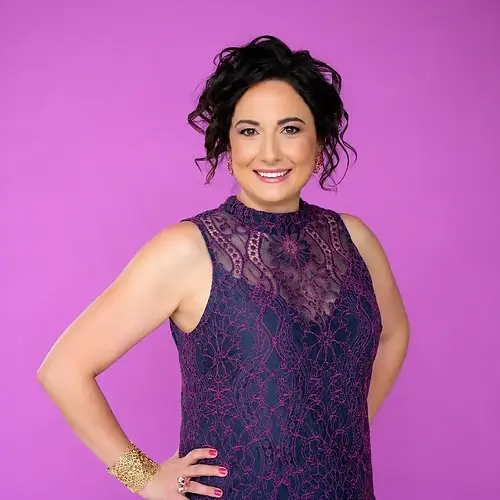



Breaking Vases: How Dima Ghawi Survived 23 Years of Death Threats to Reclaim Her Voice
Picture being handed a rule for your entire life before you're even old enough to read: stay quiet, stay pleasing, never crack. My guest this week, Dima Ghawi, was handed exactly that rule at five years old, standing in her grandmother's kitchen in Jordan. Twenty three years later, she is still living with death threats from her own father for the day she finally broke it.
Dima grew up being told she was a glass vase, perfect until the moment she cracked, and worthless the second she did. At nineteen she entered an arranged marriage and moved from Jordan to San Diego, believing the expectations would stay behind. They didn't. Her husband told her flatly that he chose her because she was like dough, moldable, uneducated, with no identity of her own to get in his way. By her mid twenties she was in a depression so deep she couldn't get out of bed, until one afternoon she couldn't reach a single person by phone and finally turned to her own voice instead.
That moment is where the real story starts. Not the vase, not the dough, but the discovery that she had a choice at all. Psychologist Dana Crowley Jack at Western Washington University built an entire body of research on exactly this pattern, what she calls self-silencing, the way women learn to mute their own needs and judgment to keep peace inside a relationship or a family. Dima lived a version of that theory in a language and culture of her own, and breaking it cost her everything she knew.
She left her marriage and her entire community, and her father responded by trying to have her killed. It sounds extreme until you learn the UN estimates around 5,000 honor killings happen worldwide every year, almost entirely against women who did nothing more than choose a different life. Dima survived hers, rebuilt herself through a master's degree and a leadership role at IBM, and now spends her career telling other women, through her memoir Breaking Vases, that it's safe to want something different. If you've ever felt like the good girl, the good employee, or the good wife has to stay perfect or get thrown away, this episode is your permission to crack the vase on purpose.
TRANSCRIPT:
Erica: Hey, girl. By now, you know I have HER Collective, my online community for ambitious women who are done doing it alone. HER Collective is for the women who are smart, capable, and driven, but they find themselves stuck on the sticky floors like self doubt, burnout, and waiting for permission that quite honestly never comes. Inside HER, you get more than motivation. You get real support, real strategies, and real momentum.
We work on things like clarifying what you want now and what's coming next, building confidence without burning yourself out, navigating hard conversations, career moves, and leadership moments with clarity, and surrounding yourself with women who actually get it. This isn't about hustling harder. It's about moving intentionally with the right tools and the right people in your corner. If you're ready to stop spinning, start choosing yourself, and build a career and life that actually feels aligned, I'd love to welcome you inside HER Collective. You can learn more and join us at www.joinhercollective.com.
Because honestly, girl, you were never meant to do this alone. Alright, y'all. Have you ever felt trapped by the expectations of your culture, your family, or maybe even those expectations you put on yourself? Today's guest, Dima Ghawi, knows exactly what that feels like, and she knows how to break free. Raised in the Middle East, Dima was taught from a young age to be quiet, to be subservient, and to follow a life path that was predetermined by her family and her culture.
But Dima found the courage to shatter those limitations, escape a dangerous situation, and become a celebrated author, keynote speaker, and advocate for unstoppable courage. And y'all know I love to talk about courage. Her story is going to leave you inspired to step off your own predetermined path, whatever that is, and create the life you deserve. You are listening to the Glass Ceilings and Sticky Floors podcast, the show that's here to empower you to break free from limiting beliefs, ditch those toxic behaviors, and unlock the infinite possibilities waiting for you. This is your time to live your best life unapologetically.
I'm Erica Anderson Rooney, your host and biggest cheerleader on a mission to get more women into positions of power and keep them there where they belong. If you're ready to shatter ceilings, crush self doubt, and build a career and life overflowing with growth and abundance, you're in the right place. Here's the deal: we talk about the real stuff here. Imposter syndrome, perfectionism, fear, burnout, you name it. It's raw. It's real. It's honest. And it's exactly what you need to level up. So grab a seat, pop in those earbuds, and let's dive in.
Today's guest has come from a part of the world where she was taught at an early age to be a follower, to be quiet, to be subservient. She was fiercely constrained by the Middle Eastern culture, the community, and family expectations that molded her to be absent of identity. Dima Ghawi is an author, keynote speaker, and a courageous leader who stepped off the predetermined path when she realized she had a choice, but that choice would lead her down a dangerous path that would require more courage than ever before. Dima, welcome to the Glass Ceilings and Sticky Floors podcast. I'm so excited you're here. How are you today?
Dima: I'm doing great, Erica. I'm excited to be talking with you today.
Erica: Oh my goodness. Well, let's take it back to the beginning. I am so intrigued to hear more about your story and where it all started. So take me back.
Dima: Yeah. It all started in Jordan in the Middle East. The story started when I was five years old. I was in my grandmother's kitchen. And usually she's fun and she creates all kinds of fun activities for us, but that specific day I remember she wasn't as fun. She was more serious.
And we were arranging flowers in a glass vase. She held the glass vase, and she said, do you see this perfect glass vase? A girl is just like it. If it gets cracked for any reason, you can never fix it. You can never glue it back, and that's the one we throw in the trash because nobody would want a broken glass. So that is the image that I was born with and raised with early on in my life. And since I was five, imagine telling a five year old this, that I have to be perfect. I have to follow. I have to obey. I cannot have my own identity. And that's what I lived with.
But then when I was 19, I got engaged through a traditional family introduction, and we got married and moved to San Diego, California. At that time, I continued to be the vase. I thought the expectations and limitations stayed with me in Jordan. But no, I laugh about it, and I say they were FedExed overnight from Jordan to San Diego, because the expectations continued to stay the same and the limitations were so much bigger than before. Living in the US was just a matter of geography. So that is where I start from, with the mindset and the mentality. And now I find myself in a whole different country alone, away from the culture, the family, the friends, and now I'm trying to discover who I am all over again.
Erica: Okay, I've got to know, why did you think that all of those expectations would stay behind in Jordan?
Dima: Because I moved to a whole new country. I saw pictures and videos and movies, Hollywood movies, of how people live in the US, the freedom and opportunities. So since I was moving here, I thought that I was going to be part of this culture and I would be allowed to discover who I am for the first time ever.
Erica: Okay. So tell me then what happened next?
Dima: So this, now I laugh about it. At that time, it wasn't funny. I was newly married and my husband was the most eligible bachelor in our community. Everybody wanted him to marry their daughters. It was actually hilarious what they would do. So they would introduce him to different young women, so he would be interested in them. So I felt very special that he chose me. And I wanted to hear from him why he picked me. I was waiting for him to tell me that he picked me to be his wife because, like, he fell in love with me at first sight, or because of my beautiful eyes, or things I heard in love songs or even Hollywood movies.
But when I asked him, I said, why me? Why did you choose me? His response was immediate. And he said, because you're like dough. And I didn't understand initially what that meant. Like, what's the meaning of being like a dough? And the surprising thing to me now is that I was not offended. What he meant by that is he was looking for a young woman with no experience, no education, no identity, so he can shape me the way he wanted, so he can teach me to see the world the way he wants. And that's why he chose me. So that's how that was the dynamic of our relationship.
When you're talking about moving to the US and the vase moving with us, even simple things I couldn't do. I could only talk to my mom twenty minutes a week on Saturday, and he had to be next to me. I was not allowed to have friends. I was not allowed to leave our home without permission. All of these things being here in the US. And I was just totally stuck. And I was always worried about the vase and challenging this norm, because that would mean that I would break the vase, and I didn't want that.
Erica: So then what happened?
Dima: So what happened was I went into a deep depression. And even though it's horrible when you think about it, depression, it turned out to be the best thing ever, because that's when I started to question the norm. And when we're talking about the glass ceiling, shattering the glass ceiling and the sticky floors and all of that, which I love the theme of your podcast, the only way we can shatter these things and get out of the sticky floors and the glass ceiling is to question the norm. And to me, when I started questioning these stories that I was told, whether it is the vase, whether it is the dough, whether all of these things, it was so difficult to do that. But when I started questioning them, I started realizing they make no sense and they have no place in my life.
I don't want to live like this. And even though I knew that if I challenged them and continued to question them, there would be consequences, we get to a point in our lives where it's worth challenging these stories, and it's worth accepting the consequences, even though they could be very painful. And in my life, they're extremely painful even twenty three years later. So that's what happened. If I did not go into depression, I would not have questioned anything. I would have just lived, following the expectations, but I believe it was the best thing ever.
Erica: Well, I don't think that this whole expectation and idea of, you know, what you saw in the movies, right, my mind immediately went to this chasing Cinderella, and I grew up with that too, thinking that I would find this prince charming who would fully financially support me, and it would just be this wonderful blissful thing. But I also didn't come all the way over from Jordan, away from my family and friends and the culture and the life that we knew. So I can only imagine that just compounded a feeling of loneliness or helplessness. Is that how you felt, or what was going through your mind?
Dima: I felt, you're right, I did feel lonely. I did feel that I did not fit in, because now, because my mindset started changing slightly, I did not fit in the overall picture that was expected of me to live.
Erica: The dough.
Dima: Yeah, the dough. And even as I was growing up, I was taught, I heard the story that people said all the time, which was that our destiny is written on our forehead. So the story of your life is already predetermined before you're even born. And you cannot challenge it. You cannot question it. You just need to live it. And that's what I believed, which now makes no sense. But at that time, I could not question the life that I was living. I could not change it, because that was the life that was predetermined for me and written on my forehead.
And when you're talking earlier as part of the introduction that I discovered that I have a choice, a big part of the choice is the choice that I can change my destiny. I can change the story. I don't have to live it and just accept it. And now, when I'm dealing and working with people from all around the world, even though they may not have been told the vase story, they're living wanting to be perfect. They're afraid of making mistakes. They're worried about being judged, and their aspiration for perfection, it's as if they're living trying to keep their ways perfect, as if they have an invisible vase, and they're taught you just accept it and you just live it. And that's why I believe your work and my work is so important, because what we're doing is we're giving people permission to question the norm, to invest in themselves, to believe that they have the power to drive change, and it's okay not to live the life that was expected of you.
Erica: And it's also okay, I'll say, and hopefully this will segue into the next part of your story, but it's okay to choose again and to say, you know what, this isn't serving me anymore, or this isn't the right decision for me anymore. So with that being said, I know pieces of your story, but talk to me about what happened next, because you're in this depression, you recognize you have a choice. What choice did you make, and how did that impact you going forward?
Dima: Yeah. And I'm glad you're asking this, because when we discover we have a choice, it's not overnight. It's not like we wake up and say, yes, great, I have a choice. It does not work like that. What happened for me is one day I woke up, I was 24, and I woke up too depressed to even get out of bed. I had no energy to leave my bed, and all I could do was just lay down and stare at the ceiling all day long. And I didn't have energy because every time I thought about the future, I would see total darkness.
So I broke the rules and called my mom in Jordan. And it was in the middle of the week. I just wanted my mom to tell me what to do and how to live my life. And thank goodness the phone just kept ringing and ringing and I couldn't get my mom. At that time, it was year 2000. So there was no voicemail in Jordan at that time. Then I called my best friend, and I couldn't get my best friend either. Then I called my uncle, and I couldn't get my uncle. And I was on the floor crying, just wanting somebody to tell me how to live my life. I needed something external.
And thank goodness I couldn't get anybody, because that was the day that I realized for the first time ever, maybe I need to listen to my own voice, because it's always there, we just silence it. Maybe I need to dig deep and discover, what do I want? What is the life that I want? And that was the first time ever that I realized that maybe I have a choice. So it's not like I have a choice, maybe I do. And just that idea that maybe I have a choice created a little tiny crack in the vase. And that's when I started feeling more motivated to work on my education, to graduate, to start looking for a job.
So when you think about it, being at the lowest point in our lives, where I could have been going lower and lower, but discovering that I don't need to listen to others, even if they love me, they may not give me the right advice, I need to listen to myself, and maybe I have a choice, that motivated me to take the right actions. And with getting my education, my bachelor's, having a job, even though it was minimum wage initially, I started developing my confidence and my experience. I got a better job after a few years, and then I realized that I don't fit at all. And that's when I packed and I escaped from my entire community, my entire world. And that was unheard of. Nobody before me ever did something like this. Just left everything behind.
Erica: No, and that's hard as it is if you are born and raised in a traditional American family, because this whole concept of divorce is still a bit taboo, even though, like, 50% of the world gets divorced, right? But you were truly escaping. You weren't just leaving. You were escaping. And so when you started accumulating these cracks in your vase, and I love this analogy because I can just see the vase, have you heard of the kintsugi bowl?
Dima: No. What is that?
Erica: Girl, you're gonna love it. So the kintsugi bowl is this whole Japanese practice of mending broken pottery.
Dima: Oh, yeah, the Japanese. Yes. Yeah.
Erica: Yeah. And looking at how they mend the cracks with gold, that's how I'm envisioning your vase. But again, as you said, it takes a lot of time to get to those places. Once you escaped, then what did you do? Where did you go? How did you get your bearings? How did you stay grounded?
Dima: Oh my goodness, there's no grounded in that. It's a total mess. So what I did is, before I escaped, I rented a small, tiny apartment in a very unsafe area, because that's all I could afford. It's a low income neighborhood. And so when I left, I already had an apartment with no furniture, because I could not afford to buy furniture, but I had a space to go to. And so I left everything behind, took my clothes and basic stuff, and I left.
And my entire community in Jordan disowned me. They considered that because that's what my grandmother warned me about, that's a crack, and then I am not going to want be wanted, and I'm going to be thrown in the trash. So they disowned me, but that's not the worst part. The worst part is that my father decided to have me killed. In my small community, and it's a Catholic community in Jordan, if a woman does anything that the father, the uncle, the brother disagree with, they kill her and they call it honor killing, and it's still happening. And many times they don't even report that, and they believe that they're bringing honor back to the family.
So to me, it's been twenty three years that I'm dealing with death threats. The only reason I'm alive right now talking to you, and hopefully it stays this way, is that my father is in Jordan. He doesn't know how to speak English and he couldn't figure out how to navigate. But the interesting thing is, like, women or anybody that is going through abusive experiences, just the threat itself is horrifying. So even though my father didn't get to me, I'm always so terrified, watching my surroundings, because, again, like, constant threat that make us live in fear. And to some people, that is enough to make us live in fear. So that is where I'm talking about being at the lowest point, being in my late twenties, lonely, barely making money alone, and also having my entire community communicate to me that I'm not good enough, I'm not worthy enough, and just, like, throwing me away in the trash by disowning me.
Erica: Yeah. No, I'm just envisioning you in your apartment by yourself with no furniture, and I'm wondering, how do you begin to climb out of that? And I know what you talk about is unstoppable courage and really shattering all of those limitations so that you can thrive. So I know we have an answer in here, I just gotta know, how do you start when you're in that low place?
Erica: Hey there, listeners. If you have ever felt like you're stuck in a place, held back by self doubt, perfectionism, or that pesky inner critic, you're not alone. We all face those sticky floors that keep us from reaching the heights we dream of. But guess what? It's time to shatter those limiting beliefs and toxic behaviors to uncover infinite possibilities. My book, Glass Ceilings and Sticky Floors, is your ultimate guide to smashing through barriers, overcoming limiting beliefs, and stepping into your full potential. This book has been endorsed by none other than the great Mel Robbins, best selling author and motivational powerhouse. It's also been featured in Success Magazine, so you know it's packed with insights that work. Inside, you'll find real life sticky floor stories, practical strategies to help you navigate your own sticky floor moments, and a whole lot of inspiration to keep you climbing. This isn't just a book, it's your roadmap to success, confidence, and freedom. Grab your copy of Glass Ceilings and Sticky Floors today at www.ericaandersonrooney.com. Whether you're in the boardroom, the classroom, or just starting out, this book is for you, because no one deserves to stay stuck, no one deserves to feel small, and you have glass ceilings to shatter. Let's do this.
Dima: It's difficult, because when we're talking about starting, what would I start? Financially, I wasn't doing well. Physically, I was afraid to be hurt. Emotionally, I was in deep depression and having low confidence. So the first thing that I did was allow myself to grieve. And that's the thing, many times we're just moving forward. I just allowed myself to grieve. I was crying. I was not doing okay emotionally, but I allowed myself to feel all of these horrible emotions. And now when I look back, I don't even feel I did enough. I should have given myself even more time to grieve. But that is the first one.
The other thing that I did is I enrolled in my master's degree, because I believe in an Arabic phrase that means knowledge is light and ignorance is darkness. And I felt that I needed to get out of the ignorance, I needed to get out of the darkness, and the only way I can do that is with knowledge, with light, bringing light into my life and connecting with people that are my age, that are interested to learn and to grow. So I enrolled in a master's in business program, and I believe it was the best investment ever. So even though I was working full time, going to school at night, studying on the weekends, I was very busy, and of course continuing to deal with all the emotional things related to the family.
And then one of my professors, his name is Doctor Starling, he reached out to me and encouraged me to run to be the president of the student organization. And I never saw myself as a leader before, I always saw myself as a follower. And for the first time ever, this man, who is my professor, saw something in me that I did not realize. So I thanked him and I said, I don't know how to be a leader. And I just kept trying to avoid him. But every time he saw me, he would encourage me. Finally, I accepted to run, and the whole journey of leadership discovery just started for me.
So to answer your question, give yourself time to grieve. Think about what knowledge you need to bring into your life. What is the awareness? What is the light you need to bring into your life? In my situation it was education, but maybe in your situation it could be giving yourself time, meditating, journaling, taking a course, whatever it is. Bring light into your life. And the third one is, be very selective of who you're surrounding yourself with. In my situation, I was fortunate that this professor just showed up and he was in my life and he encouraged me and saw my potential. But when we're going through these difficult times, it is more important than ever to avoid anybody who's putting us down, anybody who is making us feel that we're not good enough, that we're broken, and instead look for people and open ourselves to accepting help. Look for people who will help us rise, because it is time for us to rise.
Erica: I am a firm believer that the universe puts exactly who we need in our path exactly when we need it. And so you have this Doctor Starling, who all he did was pose a question to you, all he did was invite you to consider a leadership position, and that completely sent your life on a totally different trajectory, which I love. But I'm huge on these three steps that you've outlined, because I also agree that when you are becoming this new person, number one, you have to shed some of the things that are no longer serving you, whether those are the limiting beliefs, the mindsets, whether those are bad habits that maybe you have. You have to get rid of those things, and sometimes you have to grieve that process of stepping away from who that woman once was. And then you have to figure out who do you need to surround yourself with, what kind of habits do you need to be doing to become this next version of you. And so what I'm really interested in hearing is, you get this master's degree, you've unlocked this whole new version of you, what do you do with that?
Dima: Well, that's when life started. I got a job with IBM, and it was a leadership development program. They only select eight people, eight MBA graduates a year from all of the US, which I was so shocked they even selected me. And I got to live and travel around the world, and I started to manage global teams. So the world just opened up for me at a scale that I've never ever imagined before. I never imagined living the life that I was living at that time, or I'm living right now. That is not the life I was raised to live.
And so I started to manage global teams. And as I was working with people globally, I would hear them telling me about their fears and insecurities and how they want to be perfect. And to me, as I mentioned earlier, it's as if they're living with this vase, with the expectation and the cultural limitations that were stopping them from taking risks and believing in themselves, and they end up missing out on opportunities. So that's why I decided that I have a bigger purpose. I want to do this full time. I want to help people discover their potential, but also help them shatter these limitations that are stopping them. So I quit my job.
And when you're talking earlier about choosing again, initially I chose the corporate world, and I contributed and I helped my team, but now it was time for me to choose me again. And it was to start an entrepreneurship journey. And it was difficult. So that was nine years and a half ago, and it was scary. It was so scary. But it is the same thing, surrounding ourselves with people to help us, continuing to educate ourselves, watching our fears and the voice in our head that keeps telling us we're not good enough. What if I fail? What if other people are better than me? To observe all of this and continue to have shift in mindset. Because when we have a vision, when we have a purpose that is bigger than us, we just cannot stay limited being a dough. We cannot be limited with a vase. We cannot be limited with all of these things. We need to shatter them every single day and continue to grow.
And yes, expect that there's going to be limitations and fears and insecurities and failure and people that would stand in our way. We need to expect all of these things, but at the same time, there's something bigger than us that we're working towards. And we just take one step at a time, one step at a time, until we get there.
Erica: Yeah. And also, like, remember, all of these things that are happening to us, the challenges, the snarky bosses, the crazy family members, all of those things, it's actually happening for us, because you can't have the light without the dark, and we're gonna go a little woo woo here, but you can't know joy without knowing pain. And we try so hard to avoid all of these challenges and hardships. But one day, one day, Dima, we are all given the gift of hindsight. And when we get that gift of hindsight, we can look back and we can recognize, okay, those were all happening for me to become this version of who I am today. And I love that you said, it was not the life that you were raised to live. And that is such a powerful statement. I mean, that is a book title in itself, because I think so many of us just take these societal expectations and these family pressures, and we just do what we're quote unquote supposed to do. How we should be as a wife, as a mom, as a person, the dough, as you said. But you do have a choice, and you can choose to not live the life that you were raised to live. And that would, kudos to you, because we've got people left and right in the US who have that problem, and not all of their dads are trying to have them killed. So I think if you can overcome that, we can overcome anything. But Dima, if you had to go back to the Dima who was just getting that first crack in her vase, what piece of advice would you give her today?
Dima: Wow. What I would tell her is that things will get very difficult. You're going to feel disappointed. You're going to feel rejected. You're going to feel alone. But just know that things will get so much better beyond your imagination. Take it one day at a time, and don't let these disappointments stop you, because you have a bigger purpose than you've ever imagined. And these painful moments and experiences eventually will be worth it, because they're gonna make you the strong woman that you are going to be.
Erica: I love that. There's no sugarcoating. It's very practical, real advice. It's not all rainbows and butterflies and sunshine on the other side of making a choice. Sometimes you gotta go through it.
Dima: And that's why I'm glad you said that. Because many times when we have motivational speakers or we're reading books, what do we tell people? Feel the fear, take action. That is we're hurting people when we do that. It's not a matter of feel the fear and take action. Are these motivational speakers going to be there when this individual is going to take the action and deal with the consequences? No. So it's not a matter of just taking the action, it is a matter of realizing once you take it, things will fall apart. But at the same time, open yourself up to the people that show up in your life. Open yourself up to receiving help. Open yourself up to learning from these experiences, challenging yourself so you can create a better life, because you know why? Because you deserve it. So things will fall before things start going up.
Erica: I love that. It's so true. And I tell everybody, keep doing those things that push you outside of your comfort zone, because every time you do, the most amazing thing that happens is your comfort zone actually starts expanding.
Dima: Yeah.
Erica: And it's like, if you wanna talk about expansion and abundance, that's the way to do it. Lean into the hard stuff. So, Dima, tell me about your book though, because you've got an amazing book, and I want everybody here to read it, because number one, I know they're gonna be so intrigued by your story here today. But talk to me about your book.
Dima: My book, surprise, surprise, is called Breaking Vases. So obviously it's the journey of shattering these limitations, the stories, and to shatter the hell out of a vase. So that's the book. It is my memoir. It includes that entire story from me growing up with my grandmother and learning about all of these messages that I was programmed with early on. The story of getting married, moving to the US, going into the low moments of the depression, starting to question the norm, realizing I have a choice, and then getting into leadership. So if you're looking for a motivational memoir to inspire you to shatter your limitations, to question the norm, and continue to dare to thrive, that is my memoir.
Erica: Well, thank you so much, Dima, and thank you for sharing your story with us today. I know that so many people are going to hear this and say, you know what, I can do these hard things too, I can show up for myself, I don't have to wear all of these expectations, and I can be me. So thank you for your raw authenticity. It was really appreciated.
Dima: Thank you. Well, I appreciate you sharing that, and I want everybody to know that you deserve the life you want to create. Keep breaking vases.
Erica: Dima's story is a testament, y'all, to the power of courage, of choice, and of resilience. From feeling trapped in the cultural and familial expectations to embracing her voice and purpose, she reminds us every day that we don't have to live this life that we were told we had to live. We can break free. We can shatter the limitations that confine us, and we can step into the infinite possibilities that are waiting just on the other side.
So don't forget, check out her book, Breaking Vases, for even more inspiration, and thank you so much from the bottom of my heart for tuning in to the Glass Ceilings and Sticky Floors podcast. If this episode lit a fire under you, please go ahead and drop it a five star review. It's how we get the message into the hands of the women who need to hear it most. And then don't stop here, y'all. Find me on Instagram, LinkedIn, TikTok for your daily dose of inspiration, lots of free resources, and all the tools you need to keep smashing those ceilings. Until next time, stop putting a limitation over your own self and start smashing through them.
RESOURCES MENTIONED IN THIS EPISODE:
- HER Collective: join Erica's community for ambitious women who are done doing it alone.
- Glass Ceilings & Sticky Floors: follow the show so you never miss an episode.
- The AI Gap: grab Erica's book and start closing the gap for yourself.
- Dima Ghawi's memoir, Breaking Vases: Shattering Limitations & Daring to Thrive.
- Dima Ghawi's website.
RELATED EPISODES:
FREQUENTLY ASKED QUESTIONS:
What does Dima Ghawi mean by "breaking the vase"?
Dima was raised on the image of a glass vase, told that a woman is fragile and perfect until she cracks, and once she cracks she gets thrown away. Breaking the vase means questioning that story on purpose and choosing your own life even when the people around you warn you it will cost you everything. It's the idea behind her memoir, Breaking Vases, and the whole reason she now coaches other people to shatter their own limitations.
How did Dima Ghawi escape an abusive marriage and threats against her life?
Dima left her marriage and her entire community in her twenties, moving into a small unfurnished apartment she had quietly rented ahead of time. Her family disowned her, and her father decided to have her killed for the choice, a threat she has lived with for more than twenty years. She rebuilt her life through grief, education, and a small circle of people who believed in her before she believed in herself.
What is self-silencing, and why do so many women experience it?
Self-silencing is a concept from psychologist Dana Crowley Jack's research, describing how women learn to mute their own needs, anger, and judgment to keep peace in a relationship or family. Dima lived an extreme version of it, taught from age five to obey and never have her own identity. Naming the pattern is often the first step out of it, which is exactly what happened the day Dima finally listened to her own voice instead of waiting for someone else to tell her what to do.
MORE FROM ME
Follow me on Instagram @ericaandersonrooney and @joinhercollective
SUBSCRIBE & REVIEW
If you loved this episode, please take a moment to subscribe and leave a review on Apple Podcasts. Your support helps us reach more women who need these insights. Thank you for tuning in to the Glass Ceilings and Sticky Floor podcast. See you next week!
Hi, I'm Erica!
In the last 15 years, I climbed to Chief People Officer, 6x'd my income, walked away from a culture that stopped matching my values, wrote two books, and built HER Collective to help thousands of women rise to power and lead in the age of AI. I've learned a thing or two about smashing ceilings and closing gaps, and Glass Ceilings & Sticky Floors is where I open the playbook, the receipts, and the real stories to share it all with you.
_JPG.jpg)