


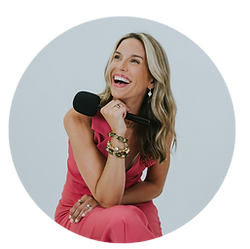


Unlocking Clarity: How to Fall in Love With Questions
You are sitting with a question right now that you have not said out loud. Maybe it is about your marriage, your job, or who you even are underneath both of those things. My guest this week, Elizabeth Weingarten, wrote an entire book about that exact discomfort, and she opens it with the question she once asked an astrologer: should I get a divorce?
Elizabeth is a journalist turned applied behavioral scientist, and her career reads like a string of question marks. She has moved through media organizations, a think tank, a behavioral science design firm, a tech startup, and now a leadership role at Udemy, and every jump started with the same thing: curiosity, not a plan. But her book, How to Fall in Love with Questions, starts somewhere lower. Early in her marriage, with the relationship struggling and a creative project she had left a stable job for also falling apart, she paid an astrologer to tell her if her husband was the wrong person. It only made things worse. The astrologer was answering a question Elizabeth never should have asked her in the first place.
That mismatch led Elizabeth to a framework she lays out using a fruit tree. A peach question ripens fast, like will I get this job, you find out in weeks. A pawpaw question takes years, like will this career change actually fulfill me. And then there is the heartwood question, the kind that never fully resolves: who am I, how do I live a meaningful life. Those are the questions Elizabeth says you are not meant to answer once and move on from. You are meant to live with them, the way you live with a marriage or a friendship, tending to it instead of demanding it wrap up.
This is not just Elizabeth's theory, it is the shape of the moment. Monster's 2026 WorkWatch Report found that workers have stopped treating uncertainty as something temporary to wait out, and are instead planning around the assumption that instability is here to stay. The American Psychological Association's latest guidance on the stress of uncertainty points to survey findings that 82% of U.S. adults say the world is changing in ways that are hard to process, and 75% feel more stressed about the future than they used to. Elizabeth's answer is not to fix that feeling. It is to change your relationship to the questions underneath it.
For Elizabeth, the reframe came through community, not certainty. When her son would not sleep and she felt like she was losing every version of herself, motherhood, her marriage, her career, what actually helped was not an answer. It was finding other women asking the exact same questions with nobody able to answer them either. If you are sitting with a heartwood question right now, about your marriage, your career, who you are underneath the title on your business card, you do not need to solve it today. You need to stop asking the wrong source for permission, and start finding people willing to sit in the question with you.
TRANSCRIPT:
Erica: Hey, girl. By now, you know I have HER Collective, my online community for ambitious women who are done doing it alone. HER Collective is for the women who are smart, capable, and driven, but find themselves stuck on the sticky floors like self doubt, burnout, and waiting for permission that never comes. Inside HER, you get more than motivation. You get real support, real strategies, and real momentum.
We work on things like clarifying what you want now and what's coming next, building confidence without burning yourself out, navigating hard conversations, career moves, and leadership moments with clarity, and surrounding yourself with women who actually get it. This isn't about hustling harder. It's about moving intentionally with the right tools and the right people in your corner. If you're ready to stop spinning, start choosing yourself, and build a career and life that actually feels aligned, I'd love to welcome you inside HER Collective. You can learn more and join us at joinhercollective.com.
Because honestly, girl, you were never meant to do this alone. Welcome to the Glass Ceilings and Sticky Floors podcast, the podcast where we get real about the challenges women face in work, life, and leadership. I'm your host, Erica Rooney, HR executive, keynote speaker, and executive coach, and I'm on a mission to get more women into positions of power and keep them there. This is the space where we call being told to lean in but not too far, to speak up but not too loudly, be ambitious but not too ambitious. Does that sound familiar? We're over all that. Here, we break down the sticky floors that keep us stuck, from imposter syndrome and perfectionism to burnout and fear, and give you real strategies to shatter those glass ceilings once and for all.
So if you're ready to rewrite the rules, own your power, and take your career and life to the next level, you are in the right place. Now today's guest is someone whose work lives at the intersection of research, storytelling, and systems change, and she's using it to help build more equitable, inclusive workplaces. Elizabeth Weingarten is the author of How to Fall in Love with Questions, but she's also a lifelong seeker of deeper understanding. With a career that defies the traditional path, Elizabeth has followed curiosity into roles at media organizations, a think tank, a behavioral science design firm, a tech start up, and now Udemy. She's led high performing teams in marketing, communications, and policy, always driven by the questions that matter the most. Why do people behave the way they do, and how can we design spaces where everyone can thrive? Elizabeth, oh my gosh, I'm so thrilled to have you here. How are you today?
Elizabeth: I am so thrilled to be here. Thank you so much for having me, Erica. I'm doing great. It's a beautiful Friday morning, so I'm happy to be here.
Erica: We gotta tell everybody that, number one, I knew this was gonna be an amazing episode when, for those of you who are watching on video, you can check this out, but she's like, I'm a mom, I've got this pile of diapers behind me. And the whole time, I had seen the pile of diapers y'all, but I'm over here thinking it's like contemporary art deco, her pile of diapers. So I don't know what that says about me, but that's just where we're living these days.
Elizabeth: This is the diaper MOMA exhibit behind me. So yes, I'm so glad it didn't seem like I was in a nursery, which I am. This is the podcast recording studio. Listen, as working parents, we do what we gotta do, and if that means working from the nursery...
Erica: I'm also gonna let you in on this fun fact, this little tidbit. I am sitting at a child's Lego table in a child sized Lego chair because it has the best background. So y'all, this is the podcast where we get real about all the things.
Elizabeth: Absolutely, I love that. And I mean, I think the kind of hangover from COVID is we are able to be inside each other's homes and lives in a way that just kind of levels the playing field and makes it feel more intimate, like you could really get to know people.
Erica: Just more real, right? Because also, let's talk about how in working motherhood, everything always has to be perfect, and we think we're all these things when in reality, we're all just click clacking away behind a pile of diapers and at the child's Lego table. That's what the big people are doing these days, guys. Oh my gosh. But Elizabeth, I wanna dive into the messy middle, right? Because you've moved from journalism to public policy to behavioral science. What connected all these dots for you?
Elizabeth: Yeah, it's a great question, and I usually talk about the fact that I really have had kind of a nonlinear career path. And I think for me, frankly, the thing that's connected all the dots has just been curiosity. Every time I've made a move from one organization to another, it's often because I get hooked on a question or a different way of seeing the world, and I'm like, oh, this is fascinating.
And what's so funny is that one of the reasons I pivoted from my career in journalism and public policy research into applied behavioral science is because of a book I read. It was authored by the same coauthor as someone we both know, Siri Chilazi. Her coauthor, Iris Bohnet, wrote a book several years ago called What Works: Gender Equality by Design. It was all about how to use behavioral science to create more gender equality in workplaces, and that completely changed the way I see the world and led to this career pivot for me.
But it's just this continuous curiosity I've had, a lot of times rooted in this question of why do we do the crazy things that we do as humans, and ultimately how do we use psychology and behavioral science to help us not only understand ourselves better, but live healthier and happier lives as a result.
Erica: And your book is all about embracing uncertainty, which, what, it's easier said than done, and it makes me a little nervous even saying it, but that is what I try to do too. So let's dive into it. Why uncertainty? Just give me the quick and dirty, how do I start to embrace it without feeling like a ball of freaking nerves?
Elizabeth: Well, first of all, I think you can start by letting yourself off the hook for this idea of embracing uncertainty, and I'll tell you more about that in a second. But as you shared, the book is really about how we get unstuck from uncertainty. My favorite definition of uncertainty, which I lay out in the book, is a sense of doubt that stops or delays progress. I love that definition because it gets at the lived experience of uncertainty. It's not just that we don't know what's happening next, it's that we don't know what's happening next and we feel like we can't move forward. We feel stuck where we are until we have all the answers. So the question I really wanted to answer was, well, how do you still move forward? How do you still live when you don't have all the answers?
And it's really rooted in a book, Letters to a Young Poet, by the poet Rainer Maria Rilke. It's a book of correspondence between him and an aspiring poet, Franz Kappus, who was nineteen at the time they were writing to each other. Kappus, as a nineteen year old, had a lot of questions about his life, lots of uncertainty. So when he writes to Rilke, Rilke very famously responds not with answers, but by encouraging him to, quote, love the questions themselves as if they were locked rooms or books written in a very foreign tongue.
The reason I bring this up, and the reason I think it's so important, is it gives us permission to do away with this idea of embracing uncertainty, and instead pursue the strategy of loving the questions. Let me tell you why this is different. We often hear encouragement to embrace uncertainty. If you've ever gone through a life crisis and picked up a self help book or listened to a podcast, you've probably heard people encourage you to just embrace uncertainty. And as you said, easier said than done. In some ways, it's almost a form of toxic positivity, because it can be easy to embrace uncertainty if it's something exciting or fun, like, hey, I don't know what my family's planning for my birthday, sure, I'll embrace uncertainty, sounds great. On the flip side, if you're waiting for the results of a biopsy, if you're struggling to get pregnant and trying to figure out if this IVF cycle is going to work, if you've just lost your job and don't know what's next, somebody tells you to embrace uncertainty in those moments, that's not gonna land well. That's super tone deaf and frustrating.
So what I love about Rilke's philosophy, and what I try to lay out in the book, is, well, what does a different path look like if we're not forcing ourselves to be so positive all the time? How do we still live better and thrive in uncertainty? One of the great things about loving the questions is you have to understand Rilke's take on love. He writes elsewhere that love is the most difficult thing that we do as humans. It's the most difficult and the most rewarding thing. Think about any long term loving relationship you have, it's not always easy, it takes commitment every day. And so does your relationship to uncertainty, so does your relationship to those big questions in your life, the questions about your relationship, career, identity, love, loss. What's really freeing about saying, hey, forget embracing uncertainty, I want to love the questions, is all of a sudden you have permission to feel all the things. Some days you might feel like, yeah, I don't want to embrace uncertainty today, this is really hard. Other days you're maybe excited about it. It opens up this full spectrum of emotions. And the most important part is that you're committing to it, that you're committed to the questions of your life, and committed to seeing out the answers as they ripen.
Erica: I love this mindset shift, and it reminds me, I was just in New York City yesterday, and I did a VIP day with a keynote person. He was reviewing a lot of my manners, was on stage, things like that, and one of the things he told me was, you move around too much, so you need to not move as much. But he's like, I don't want you to think about it through the lens of don't move, don't move, don't move, because then all you're gonna do is move more. Instead, figure out why you're moving so much, figure out why you're doing these things, and then you'll stop. And it just connected for me, because yours is such a mindset switch. It's not just, fall in love with the unknown, because that's not always something we want to be falling in love with, but it's falling in love with the questions. And in the beginning of your book, you jump in talking about astrologers and all of this other stuff, and it cracked me up because I was like, yes, I've done all of those things. I have paid good money to have people tell me stuff that, I don't know, and I'm not saying it's not real.
Elizabeth: I don't know enough about the world, but I do know that it is our way of seeking certainty. Totally, and so what you're pointing to is, the book is really about how do we fall in love with questions, how do we learn to love even the most painful questions of our lives. But how do we do it, in particular, in a world in which so many of us have become addicted to fast, easy answers? So what you're talking about is I detail in the book all of the different people and spaces and organizations that I've labeled the charlatans of certainty. These are the types of people and organizations that manipulate people into thinking they have all the answers to their deepest questions. These are the types of questions that really only you have the answers to, but you might see particular gurus claiming, no, I know better than you, and if you want to know the answers, keep paying me money, and eventually you'll gain enlightenment or whatever it is. There are lots of examples of this throughout our culture and society.
But something I learned on my personal journey, because a big part of the book is tracing my own messy journey to forming a different relationship to the big questions and uncertainty in my life, I do talk about my own experience with astrology and astrologers. One of the things I learned, I was really struggling in my marriage early on. I write about this question I start the book with: should I get a divorce? I was early in my marriage, it was failing. I also was in this space in my life where I had recently left a job to pursue a creative project, and that was also failing. So I was asking not only this relationship question, but this career question of what am I doing with my life.
In that space, so often what we do is seek out answers from other people, we seek out certainty because it's so uncomfortable to sit in the uncertainty ourselves. So I think, like many people, I sought an answer from an astrologer, even though part of me was like, well, I don't believe in this, I don't think this is real, and yet I was asking this astrologer about my relationship, something so deeply important to me. The astrologer told me she didn't think my partner was the right person for me. I was very upset after that conversation, even though I had told myself I don't believe this is true.
It was only later, when I talked to another astrologer for the book, who called my attention to the fact that there was a mismatch between the question I was asking and the source I was seeking, that I understood. The idea there is that it's not wrong for us to seek answers, we are biologically wired to want to seek answers and certainty in our environment, sometimes that's a really good thing. What trips us up sometimes is when we're seeking answers from the wrong source. So a big part of the book, and a big part of what I write about, is the importance of getting really clear on the questions we're asking, and on what we're really seeking when we're struggling with uncertainty. Sometimes it's answers, sometimes it's something else, sometimes it's connection. When you get really clear on the question you're asking and what you're really seeking, you're more likely to select the right source for that answer, and sometimes it's not going to be an astrologer, sometimes it's going to be a different source for you.
But that was a really important insight and shift for me, because I realized, an astrologer I talked to told me, you wouldn't seek relationship advice from a friend of yours who is always choosing the wrong person, who's always dating losers, right? You wouldn't ask your friend, hey, what do you think about this particular partner I'm thinking about? So in the same way, you have to be really smart about what source you are selecting to help you find answers or certainty in the world.
Erica: I did love how you dove right into your marriage and that piece of it, because I think there are so many women out there who question that at some point in your life. I always make the joke of, are you really married if you haven't thought about how you're gonna do away with your spouse one day? But I think everybody's been there, and it's such a real thing. And it's like, we're going to these outside sources that don't have any clue about our relationship. So in instances like that, what do you think people are seeking? Is it validation as well? What is it?
Elizabeth: Yeah, what I found from my reporting is that often in those moments where we're so desperately seeking an answer... and I should say, it's not that we're so desperately seeking an answer, but the question we're asking is one of these big life questions. Let me take a step back and share a little bit about how I've defined the types of questions in the book, because I think it's important to understand what questions I'm talking about here. We're not talking about the what's for dinner question.
Erica: We can live with that kind of uncertainty.
Elizabeth: Exactly, exactly. So in the book, I liken the different types of questions to parts of a fruit tree. The first type of question is a peach question, one that really quickly ripens into the fruit of an answer. Peach questions are like, will I get the job? You'll find out in a few weeks if you get that job. The next type is a pawpaw question. Pawpaw trees take five to seven years to grow their fruit, so a pawpaw question still ripens into an answer, but it takes longer to get there. Maybe that's, will I feel fulfilled by this career change? You'll maybe learn the answer after a few years.
The third type is really the type of question the book deals with most, and that's the heartwood question. What I learned in reporting for the book is that heartwood is the part of the tree that gives it its stability and balance, and it lives with the tree for its whole life. So you can think about these questions as your lifelong companions. These are questions like, who am I, how do I live a life of meaning and purpose. These are questions that aren't really answerable in any permanent way, but they stick with you throughout your life.
The final type, on the questions tree, are dead leaves, questions you're often better off releasing and letting go, questions that keep you stuck in patterns of regret and rumination. So when it comes to these big questions, like the heartwood questions, or questions about relationships, it can feel really easy to get stuck in them, because they're so big and heavy and can be scary and painful. What I found is that oftentimes, yes, we're seeking answers, but we're also fundamentally seeking connection in those moments.
They can feel really lonely. If you're questioning your marriage, if you're not sure what you're doing in your career, especially when we get into our thirties, forties, and fifties, there's this idea that we should have had it figured out by now. There's a lot of pressure and expectation, particularly on women, to have it all together. So I think especially for us, it can feel really lonely to be questioning these central parts of our identity. Instead of learning tools to sit with our questions, and I can talk about those tools and the key elements of what I call a questions practice, we consult all the influencers, the gurus, or we go on AI, or we Google. There are all sorts of sources we can check, but they're not actually slaking that thirst and hunger for what we really want in those moments, which a lot of times is connection.
Erica: Yes, and that actually leads me right to where I want to go, so this is great. But you have this whole making your questions map thing that comes into play. Tell me more about that.
Elizabeth: Yeah, so the questions map, I designed to help people not necessarily find answers to uncertainty, because as we just talked about, sometimes you're not gonna find an answer if it's one of these big questions. But the idea is using the map to help you find clarity, so that you're still able to move forward, still able to live the questions of your life instead of feeling stuck in the unknown.
The idea with the questions map is that it takes you through a guided set of prompts and reflections to help you first really identify what is the question I'm asking, what is the big question, or maybe a set of questions guiding my life, and then, are these the right questions, and we can talk more about that too, how do you know if it's the right question, and then moving through to understanding what's the action I can take on some of these questions now. How do I find the right community to help support me in finding the answers, and how do I commit to this, how do I commit to this question and this practice.
What I found in my work is that there are four key elements to developing a questions practice, and you can think about a questions practice the way you think about a yoga or meditation practice, some time for you to really explore and commit to these big questions guiding your life. When you think about changing our relationship to uncertainty by changing our relationship to these big questions in our lives, well, you don't change your relationship with someone if you ignore them all the time. So the idea is, let's find some regular time to sit with our questions and get to know them a little better, and that's how you really change your relationship to them.
The first part is curiosity, learning how to approach our questions with curiosity rather than fear. The second part is conversation, learning how to have different conversations with yourself when you're in periods of uncertainty, because I can very quickly have an anxiety spiral, and how do we stop that from happening. The third part is community. As I was talking about earlier, community is so important for allowing us to sit in uncertainty for longer, and it makes sense because community evolved to make us feel safe and secure. There's great neuroscience research showing that when you feel embedded in community, your cortisol levels drop, and the parts of your brain that identify reward light up. So this is very powerful stuff. And then the fourth part is commitment, not only committing to exploring your questions and giving them time to ripen into answers, but also knowing when to let those questions go like dead leaves, when are the questions no longer serving you, no longer moving you forward.
Erica: I've got the questions map right here in front of me, okay, like I know how to follow this flowchart, so y'all grab her book, you can get it on Kindle, that's where I have it, but you can get it anywhere. She really does have this amazing start here and then you flow down, yes or no, and it's a really great tool to dive into. But I would love to dive into the curiosity piece, because I think that has become such a buzzword in the corporate world of, just be more curious. And I love that, I think it's super important, but where I get hung up and where I get stuck is often my first reaction is not to be curious, it's to be judgmental.
Elizabeth: Yeah, interesting.
Erica: So how do I be more curious and less judgmental?
[Sponsor message: Hey there, listeners. If you have ever felt like you're stuck in a place, held back by self doubt, perfectionism, or that pesky inner critic, you're not alone. We all face those sticky floors that keep us from reaching the heights we dream of. But guess what? It's time to shatter those limiting beliefs and toxic behaviors to uncover infinite possibilities. My book, Glass Ceilings and Sticky Floors, is your ultimate guide to smashing through barriers, overcoming limiting beliefs, and stepping into your full potential. This book has been endorsed by none other than the great Mel Robbins, best selling author and motivational powerhouse. It's also been featured in Success Magazine, so you know it's packed with insights that work. Inside, you'll find real life sticky floor stories, practical strategies to help you navigate your own sticky floor moments, and a whole lot of inspiration to keep you climbing. This isn't just a book, it's your roadmap to success, confidence, and freedom. Grab your copy of Glass Ceilings and Sticky Floors today at ericaandersonrooney.com. Whether you're in the boardroom, the classroom, or just starting out, this book is for you, because no one deserves to stay stuck, no one deserves to feel small, and you have glass ceilings to shatter. Let's do this.]
Elizabeth: So first of all, I think that's a really interesting question. What I suggest in the book is, first of all, I don't think it's always bad to be judgmental. That's also this interesting place where we tend to say, oh, that's bad.
Erica: We shame ourselves all the time.
Elizabeth: Right, exactly, exactly. So judgment isn't always bad. What I would say, or the question I would ask, is, is my judgment helping me get closer to something that is true for me, something that I want, or is my judgment cutting me down and making me feel worse, or less than, or not enough? When we think about starting with curiosity, where I'm really focused in the book is getting curious about these big, sometimes painful questions that exist in our lives. I could see a judgment mindset being, okay, this is my question, and then, oh, this question is stupid, or this isn't a good enough question, or why am I asking this question, I shouldn't be asking this question. I've been there too, wishing I wasn't in a particular place, or wasn't asking a particular question, or felt something different.
I think the prompts I have encourage you instead to get curious about, well, if I'm feeling this way about this question, is there a different question I could ask, what could that different question be. And some of the things I've learned that make for a great question is, are you asking a question that's binary versus a question that's open, because that gives you a more open field of possibilities for answers. At the beginning of the book, I was asking, should I get a divorce, and what I learned was that actually wasn't a great question for me, because it was binary, and I didn't like either answer. I didn't like yes or no, because yes, I didn't actually want to get a divorce, and no meant I wasn't acknowledging the deeper challenges and questions that still existed. It wasn't like a, no, I'm not getting a divorce and everything's fine.
So I think when you're judging your question, it can actually be a good thing, as long as you're trying to identify what's a question that's actually going to feel more healing for me, that's going to help me move forward from feeling stuck to feeling like there are more possibilities. One way is to open it up from a binary to a question, for me the question became something like, how do we both have to change in order to be in a relationship together, what does that look like. And the other piece I think is really important is asking, does this question lead me back to what I really want and need in this moment. What I found is that the best questions serve as an internal GPS. So I think when you're judging your question, not necessarily a bad thing, but if you can ask yourself that, it can convert it from that kind of negative judgment to a generative, positive judgment.
Erica: I love all of that, tons of food for thought in that one piece of it. And I don't want you to give away everything in the book, because I think it's an amazing book that everybody should read, but I love how you end it talking about finding the courage. And I think that is such a big piece, because when you're asking these big life questions, like should I stay married or not, that takes a lot of courage to even ask yourself that question, because obviously nobody gets married thinking, I want to get divorced down the road. So where do we find said courage? Is there a fountain, like the fountain of youth? What are we doing here?
Elizabeth: You got it, that's the end of the book, there's a map to the fountain of youth that I put in there. I won't share where the fountain of youth is, but buy the book and you'll find it. One place where I've learned courage exists is actually in the questions themselves. What I mean by that is questions connect us not only to ourselves more deeply, but they also connect us to other people. Going back to the importance of community, something I've found particularly as a new mom is that anybody who's a parent knows that parent life in general is just full of uncertainty. Every single day, every question, from the small questions of what type of diapers do I get, to the really big questions, like how is my identity changing now that I'm a mom, you're swimming in a sea of uncertainty all the time.
Something I found was that what gave me courage in some of those scary, painful moments was not necessarily googling the answers, but knowing that other people were facing the same questions I was. I actually wrote about this a couple of months ago around Mother's Day. Early in motherhood, I was really struggling because my son was not sleeping at all. At first I was really focused on how do I get him to sleep, I was doing everything, nothing was working, getting four or five hours of sleep every night, which is not sustainable for life. But what I realized was it was only partly about the sleep, because I was kind of freaking out, on my last thread of sanity. It was partly about sleep, and partly about how challenging it had been to find who I was again after he was born, and also partly about trying to co-parent with my partner, and partly about going back to work and not knowing who I was anymore. There were all of these things wrapped up in what I was so focused on. If I just address the sleep thing, I thought, all my problems will go away and I won't feel this anxiety and uncertainty anymore.
But once that felt addressed, I still felt this sense of anxiety, and I realized there were these bigger questions hiding behind it. I bring this up because what really gave me the courage to keep moving forward in those moments was connecting with other moms who were like, yeah, I'm also asking these questions, and I also don't know the answers. Can we just accompany each other? We don't need to tell each other the answers, we don't need to know the answers, but we can move forward as long as we feel like we're not alone. For me, that was a really important and profound way of being able to get unstuck.
Erica: Yes, and what's coming to my head now is this idea that we all believe our life is gonna go this exact certain way. Graduate all the schools, get all the degrees, marry the right people, get the right jobs, check, check, check, and climb that corporate ladder. We all think that's what it's gonna be, but life is so much more complex than that, it's never straightforward like that. But what also got stuck in my brain is how important this is gonna be again for all the women who are now empty nesters, because that's a whole other identity crisis, and I've been talking with a lot of women now who are like, I don't know what the hell to do with my life.
Elizabeth: Totally. You're pointing to something so important, which is, if there's one pattern of the people I talked to in the book, and the people I've been hearing from where the book is really resonating, it's people going through transitions. That can mean so many things, the transition into the workforce, the transition into a new job, the transition out of the workforce, retiring, the transition from being a parent to being an empty nester, losing a parent, becoming a parent. There are so many moments in life where we're asking, who was I before and who am I becoming now. These are the big heartwood questions that are so critical to explore through questions mapped, through questions practice, and to really understand, or else you miss out on an opportunity for growth, for deeper connection to yourself, deeper understanding, and ultimately understanding the full slate of possibilities for the next chapter, which is so exciting.
Erica: Is there one question you think everybody should be asking themselves right now, or at some point in their lives?
Elizabeth: Somebody recently asked me a question I thought was so interesting, which was, if America is asking itself a question right now, what is that question, the kind of collective question of this country. And the question I think we're all, to some extent, asking right now is, if change, upheaval, uncertainty is the new normal, which I think it is, how should that change the way that I am in the world? To me, that's a really important question, something I'm asking myself and trying to live every day too. If I accept the premise that this idea of control, or predictability, or certainty, isn't there anymore, and probably never really was, but it's very apparent it's not there now, well, how do I want that to change the way I'm showing up? To me, that's an important question for right now. And I would also say, the question I'm living, I don't know if it's a question everyone should ask themselves, but I certainly think it's important particularly for women who identify as having a really strong relationship to their career, and that's a big part of their identity, is, how do we define our self worth outside of our achievements and accomplishments at work? That's a big question I continue to live and continue to try to love, but maybe that's a question that's, for folks listening, something that resonates with you too.
Erica: First of all, I thought the question you were gonna say all of America should be asking right now was, what the fuck. But not that. That's the question I have.
Elizabeth: Maybe that's also a question.
Erica: Yes, I love it. But I digress. I'll tell you, to piggyback off what you said, I once had an individual ask me, kind of like the thing we all do in America, tell me about yourself, who are you? And I was like, oh, I'm an author, I'm a speaker, blah blah blah. And he was like, well, who are you besides being an author and a speaker? And I was like... I'm a wife, I'm a mom. He's like, who are you when you're not a wife and a mom? And I was like, I don't know, what are you doing? And so, needless to say, that was a question that really stuck with me, because it's like, if you peel away all of those things, really, who are you at your core? For me, I'm a lifelong learner, I'm a curious person, I'm someone who loves travel, health and fitness is very important to me. But it was such a moment for me to see, because that ties to different external words, right, which is exactly what you're talking about. It's like peeling all that away, that could very well be a lot of our life's work. I found that so interesting.
Elizabeth: I think that's totally right. For folks who are figuring out, well, how do I even answer that question, one place to start, and you alluded to this too, is, what are your values? I talked to a doctoral researcher at Baylor University who's done a lot of research on how you define your sense of worth outside of accomplishments and achievements. She was a lifelong athlete and found she was way too attached to her performance on the field, letting it determine her full value as a person. She found that when people can root their sense of identity and worth more in values, like being curious, being a lifelong learner, being humble, it can help you not feel quite as anxious and fearful when something doesn't happen at work that you want to, or you lose your job, or something happens where you aren't achieving or performing the way you always had wanted to.
Erica: Yeah, amazing, amazing, I love all of that. And I also think what's so important about core values is it not only helps you figure that piece out, but it also helps guide your decisions. That's really what I use it for in my day to day, and I find that so incredible. But Elizabeth, I want to thank you so much for being here, sharing your story about all the hard things, and talking so much about the book. I think it's such a great time to fall back in love with questions and go a little bit deeper. So tell people, where can we buy your book, where can we find you, how can we connect with you?
Elizabeth: Yeah, absolutely, thank you again for having me here, Erica, it's been such a fun conversation. You can find me at elizabethweingarten.com, you can find information about my work and the book there. I also have a Substack called Time Travel for Beginners, so I'd encourage everybody to follow me there. It's sold anywhere you can find books, Barnes and Noble, Amazon, all of the places.
Erica: Boom, I love it. And if today's conversation gave you goosebumps, or just made you say heck yes, then here's what you need to do next. Share this episode with a friend, drop a review, buy my girl Elizabeth's book, and let's keep this conversation going. Remember, your potential is limitless, and the only thing standing in your way are those sticky floors. But guess what, you have everything you need to rise above them. So go up there, take up some space, and let's shatter some ceilings together.
RESOURCES MENTIONED IN THIS EPISODE:
- Ready to close your own gap and get more women into rooms of power? Join HER Collective, Erica's community for women in corporate America.
- Book: How to Fall in Love with Questions by Elizabeth Weingarten.
- Elizabeth Weingarten's website.
- Time Travel for Beginners, Elizabeth's Substack newsletter.
- Letters to a Young Poet by Rainer Maria Rilke.
- What Works: Gender Equality by Design by Iris Bohnet.
RELATED EPISODES:
FREQUENTLY ASKED QUESTIONS:
What is a "heartwood question" in Elizabeth Weingarten's book How to Fall in Love with Questions?
A heartwood question is Elizabeth Weingarten's term for the big, lifelong questions that never fully resolve, things like "who am I" or "how do I live a life of meaning." She compares them to the heartwood of a tree, the core that gives it stability and stays with it for its entire life. Unlike a "peach question" that ripens into an answer in weeks, a heartwood question is meant to be lived with, not solved.
Why does Elizabeth Weingarten say to stop trying to embrace uncertainty?
Weingarten argues that "embrace uncertainty" is often toxic positivity, easy advice for an exciting unknown but tone deaf for a biopsy result or a job loss. Her alternative is to fall in love with the questions themselves, an idea she borrows from the poet Rainer Maria Rilke's advice to live the questions rather than force an answer. That shift gives you permission to feel however you actually feel about the uncertainty, instead of performing an acceptance you don't have.
How do you turn a painful yes or no question into a better one?
Weingarten found that binary questions, like "should I get a divorce," trap you because you don't like either answer. She suggests opening the question up, asking something like "how do we both have to change to be in this relationship together" instead, which creates more room for possibility. A good question, she says, should feel like an internal GPS that points you back to what you actually want and need.
MORE FROM ME
Follow me on Instagram @ericaandersonrooney and @joinhercollective
SUBSCRIBE & REVIEW
If you loved this episode, please take a moment to subscribe and leave a review on Apple Podcasts. Your support helps us reach more women who need these insights. Thank you for tuning in to the Glass Ceilings and Sticky Floor podcast. See you next week!
Hi, I'm Erica!
In the last 15 years, I climbed to Chief People Officer, 6x'd my income, walked away from a culture that stopped matching my values, wrote two books, and built HER Collective to help thousands of women rise to power and lead in the age of AI. I've learned a thing or two about smashing ceilings and closing gaps, and Glass Ceilings & Sticky Floors is where I open the playbook, the receipts, and the real stories to share it all with you.
_JPG.jpg)