


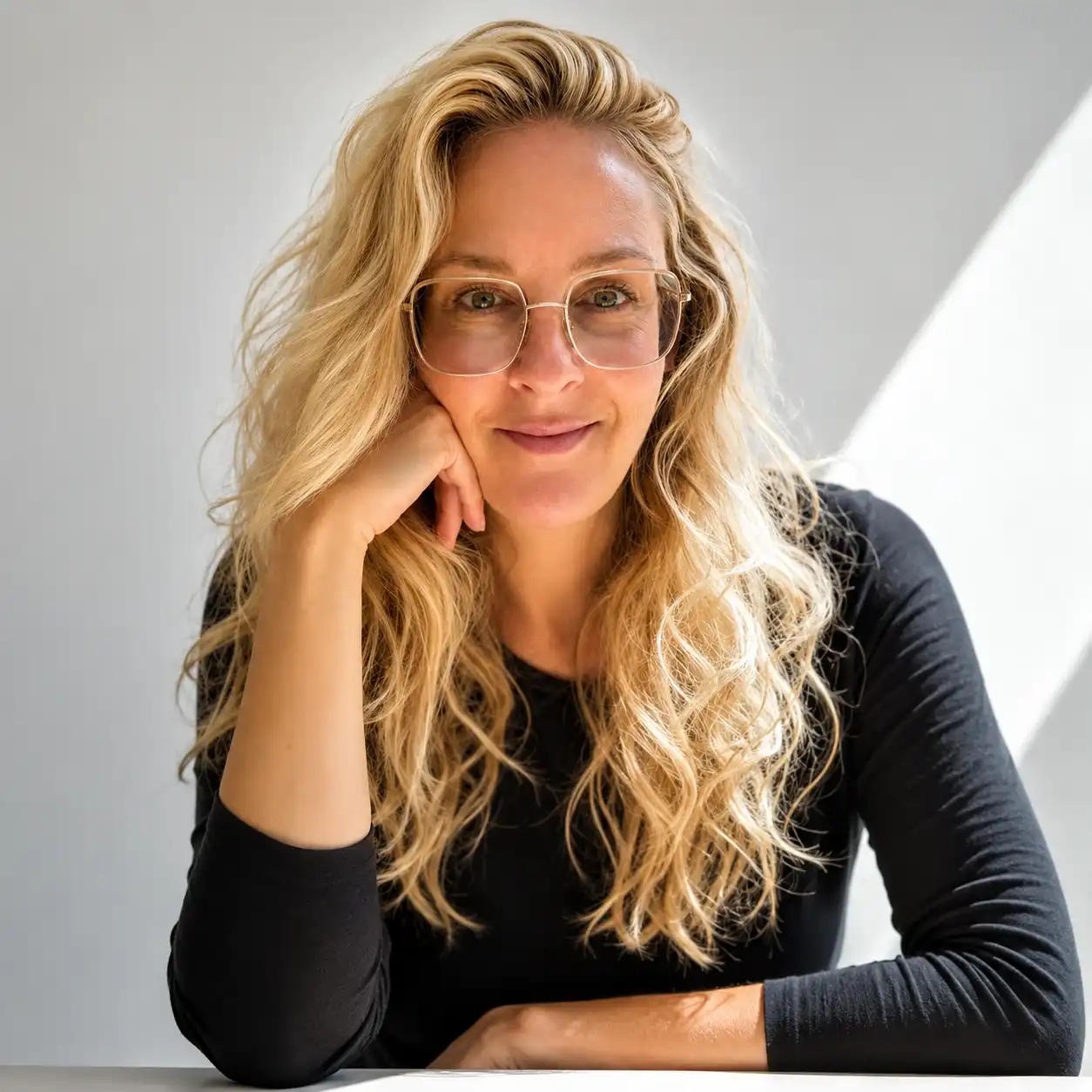


20 Years in the C-Suite, Then She Realized She'd Climbed the Wrong Ladder
Look at your career right now. If someone put you on the spot, could you honestly say you belong in the room you fought so hard to get into? My guest this week, Danielle Mueller, spent twenty years as a successful corporate executive. Then she woke up in the C-suite one day and asked herself a terrifying question: had she climbed the wrong ladder the whole time?
Danielle grew up in LA, raised by diehard atheists, and built a career on following her gut instead of the rulebook. She eventually became chief strategy officer of a branding agency she co-ran with a close friend, sitting at what looked like the top. Then a values clash with the agency's founder blew up the partnership, and Danielle found herself at the top of a ladder she no longer wanted to be on. That professional divorce sent her back to what her gut and her heart had been telling her all along, and human design became the map that finally named things about herself she had sensed quietly her whole life.
So what is human design? It is an energy blueprint, an energy mapping system built from astrology, the I Ching, Kabbalah, and the chakra system, that Danielle now uses to help people see which decisions and energies come naturally to them. She pairs it with somatic and nervous system work, because she believes the body holds a decision-making strategy the mind alone cannot access. Her core idea is clarity above certainty. Nobody actually has certainty, so the goal is not a fixed roadmap. It is the next right step.
Danielle is blunt about the cost of chasing certainty instead of clarity. Even at the top of her game she battled imposter syndrome, and she is far from alone. A KPMG study reported by Forbes found that 75% of women executives have experienced imposter syndrome in the workplace, with many saying the feeling gets lonelier the higher they climb. Danielle traces her own version of it straight to her nervous system, the visceral discomfort of claiming something new for herself before she has fully integrated it. Leadership researchers increasingly back that instinct too, pointing to somatic awareness as a real driver of clearer, calmer decision-making under pressure, not just a soft add-on to strategy.
If you have ever felt like your resume does not match how small you feel on the inside, or you keep waiting for a certainty that never arrives, this episode is your permission slip. You do not need the whole map. You need the next energetic breadcrumb, a nervous system calibrated to hold what is next for you, and the willingness to trust your own inner authority over anyone else's roadmap.
TRANSCRIPT:
Erica: Hey, girl. By now, you know I have Her Collective, my online community for ambitious women who are done doing it alone. Her Collective is for the women who are smart, capable, and driven, but they find themselves stuck on the sticky floors like self doubt, burnout, and waiting for permission that quite honestly never comes. Inside HER, you get more than motivation. You get real support, real strategies, and real momentum. We work on things like clarifying what you want now and what's coming next, building confidence without burning yourself out, navigating hard conversations, career moves, and leadership moments with clarity, and surrounding yourself with women who actually get it. This isn't about hustling harder. It's about moving intentionally with the right tools and the right people in your corner. If you're ready to stop spinning, start choosing yourself, and build a career in life that actually feels aligned, I'd love to welcome you inside her collective. You can learn more and join us at www.joinhercollective.com. Because honestly, girl, you were never meant to do this alone. Okay, friend. Today's guest is going to blow your mind. She is confident. She is successful and she is paving her own path through this thing called life. Danielle Mueller was at the top of her corporate ladder game, sitting in the c suite, but like many of us, woke up one day and realized, oh, crap. I've climbed up the wrong freaking ladder. Listen in while she shares her story of self discovery and curiosity. You might be surprised, like I was, to find that this wildly successful woman struggled with imposter syndrome and knowing her worth. We cover confidence, self love, trusting yourself, and what I found most intriguing, our desire for certainty. Y'all are gonna laugh as she quite literally calls me out on my BS as I try to pin her down with a roadmap to certainty. Are you ready? Alright, friends. I've got great news. Success does not have to feel like a grind, but it does lead me to a really important question. We are all out here chasing growth and all about climbing ladders of success, whatever that might look like for you. But how do you know that you're climbing the right ladder? What can you do if you're climbing the wrong one? Do you have to start over? Now I want you to imagine a future where you level up while living well, own your power, find your voice, and love your life. And, yes, I stole that directly from my guest today's website. That is what she is all about. She is also known as the spiritual executive. Danielle Mueller believes that you deserve to live an inspired life, rich with purpose and guided by instinct, and that it's time to integrate spirit and work. She specializes in helping people alleviate stress, foster prosperity, and find fulfillment. So hello, and sign me up for that. Danielle, how are you?
Danielle: Hello. Well, thank you for that introduction and for inviting me on. I feel really privileged to be here having this conversation.
Erica: Well, I feel very privileged to be connected to you in having this conversation. So thank you. So you come to us with twenty years of experience as a successful executive. And today, you're a somatic practitioner, you're an executive coach, and a human design guide. So I've already got questions. But my first one is, how did we get here to this place?
Danielle: I mean, how long do we have?
Erica: The we need.
Danielle: Okay. So let's see. Well, at first, I wanna say that I grew up in LA, and I was raised by diehard atheists. So when I talk about, spirituality, I am talking about whatever uplifts your spirit. So I am not religious. I am a person who has always been curious, and I've always been seeking. And, ultimately, what I've realized is I've always been seeking a deeper connection to myself, and that is sort of how I contextualize spirituality for those that maybe are spiritually curious as opposed to feeling fully invested in whatever that is for them. I have had a very wacky, nonlinear career path. I have always been a bit of a weirdo, and I I do not say that in a disparaging way. I love that about myself. And I've always just been one of those people that I was just put here to question the status quo. I wanna know why. Why do you do it that way? Why do we think that? Does it really have to be that way? And I don't do well-being told what to do. I have to sort of feel my way through things, find my own way, and experience things for myself. I've always had a sort of quirky relationship to my career. I am and have always been highly ambitious, driven, super, I don't know, competent, productive, whatever. But I never really fit into any of the conventional norms, standards, institutions. I really just didn't fit. So there was always a lot of tension. Right? And so I've always been sort of walking this path of figuring out where I fit in and also kind of embracing not fitting in and seeing how I can optimize and maximize the impact of that. So I've had this very long linear career. I've been in a lot of different businesses. All of this to say that I have really followed my curiosity and my gut, and I I have really just followed those energetic breadcrumbs and not paid too much attention to how I was, quote, unquote, supposed to do it. And so I built a lot of skills, and I have a lot of experience under my belt. And I was always looking for the next thing. I'm very oriented to, okay, what's up next? Most recently, before starting the spiritual executive, I ran a branding agency in partnership with a dear friend of mine, and I was at the top of the ladder. I was chief strategy officer of this agency. At the time, I loved what I was doing. I loved the actual work. But behind the scenes, there were some politics and some things going on that weren't aligned with my values. And the founder of the agency had an idea about where he wanted to go directionally with the company that did not align with my values. And so I found myself at the top of the wrong ladder looking around going, uh-oh. Now what? Went through a professional divorce as as a result of some of that stuff. This dear friend of mine and I, we went in separate directions. And I just decided to lean into what I've always done and who I've always been, which is what is my gut telling me? What is my heart telling me? And what do I see as a need out there in the quote, unquote market? And that is how I landed here. I also I ran into human design in the midst of all of this. And human design illuminated things for me that I had known about myself quietly in the background, maybe for my whole life, that I couldn't quite put my finger on or didn't know how to articulate. And suddenly, this very esoteric system was naming it for me in such a brilliant way. And I guess in some ways, the puzzle pieces just all sort of came together. And I really found, like, a new deeper relationship to myself and a new deeper relationship to what I wanted to be doing in the world.
Erica: So expand on human design for me because I'm going to wager that we've got a lot of people listening who are like, what is she even talking about?
Danielle: Yes. So human design is an energy blueprint. It's an energy mapping system that is based in astrology, the I Ching, and Kabbalah, also the chakra system. And it is a very esoteric system that came into the world in the eighties. Some people think it is, you know, as they say, very woo woo. And being a person that comes from atheist parents, scientific materialists, and then having this very practical business career, I feel like I'm a bridge. I love the very esoteric, the the ancient wisdom traditions. They really appeal to me. I bring a lot of curiosity, so I don't actually need to know whether it's true or not. I just need to know how it feels for myself. And so I just invite everyone that's investigating human design to try it on in that way. And what I love so much about it is at its foundation, it is teaching us to really tap into the wisdom, intelligence, and authority of our body and our own wisdom, intelligence, and authority. So to trust our inner authority above any external authority. And that's what really fundamentally appealed to me. Let's go a little deeper into what do I what I do. So I I got very into the human design, which is this energy blueprint. And this energy blueprint connected me to myself, and it connected to me me to my body in a way that I had not been connected to my body. So in the culture that we live in, which is very driven obviously by capitalism, product activity, all of that kind of stuff, we are actually relatively disembodied as a culture. We are not giving ourselves the space to feel into the body. We're up in our heads all the time figuring stuff out and making stuff work and solving problems, analyzing. And there's a balance that we're seeking. So that led me to become a somatic practitioner. I really wanted to understand what it meant to be embodied. I wanted to study the nervous system. The nervous system is being talked about a lot in relationship to trauma, but I like to talk about it in relationship to, let's call it, like, capital t trauma and little t trauma. So little t trauma is sort of the everyday stuff. It's the stuff that we engage with at work. Right? The disagreement or the feelings of maybe inadequacy or, you know, worrying about not doing it right or whatever it is. Having the boss that's super authoritarian. You know, all of that stuff all has an effect and impact on our nervous system and is in fact triggering, sense memory that's already built into the nervous system from whatever our childhood experiences are just, you know, being in this world as a human. So I started to study that, and so I started to bring those two things together. So human design for me is like a map. It's like a guide. I can look at your chart and understand to some degree what energies come naturally to you and where potentially there is the opportunity for shadow work that could really break some new opportunity or new way of being open for you. Then we bring in the somatic work and the nervous system work to connect to decision making strategies that are not in the head. So that's part of the beauty of human design is that it proposes that everybody has an essential innate decision making strategy within them. And I can guide you to find that so that you can find more ease in making decisions. And then something I've always loved and always done for myself and then mapping out an actionable path to executing that vision. And the difference now is that I really infuse that vision work with this idea that you want to craft vision without turning vision into an agenda. So I think we're also addicted to doing results, agenda, the way things are supposed to be, the way things are supposed to look. You know, success has this very conventional spin on it, and I want us to question all of that. And so vision without turning it into an agenda and the idea of clarity, which is more flexible. Like, clarity is a moving target. Right? You can feel really clear about something in one moment, and then things in the world change and you come to a new level of clarity. So clarity above certainty. Right? I like to break up this notion of certainty. Nobody has certainty. And there is no
Erica: was gonna say. I was like, I think we come into this world where we're like, these are all the things I'm gonna do. And if I do x, y, and z, then I will be happy and successful and and then shit happens, and that's never the case.
Danielle: Yeah. Exactly. So I love the idea of cultivating a new relationship to all that stuff and really questioning. Like, I I talk a lot about internalized capitalism. And, unfortunately, a lot of people hear anti capitalism, and that's not what I'm talking about. I'm simply talking about the fact that this world, this material world that we live in, was built on capitalist values that teach us to prioritize productivity and profit over feeling and well-being. Right? So it's worth questioning that because the things that we sometimes perceive as being true are actually just ideas that we've been thinking over and over again for a very long time.
Erica: Yeah. It's what we've been taught, so we just assume that it's true.
Danielle: And I wanna know what's true for you, and I wanna know what's true for me. This is life's work. That's what inspires me because it's always changing.
Erica: Yeah. It's a journey. It's a journey. And it and there is no I mean, we're all headed to the same destination. Right? But there Yes. But there is no it's just it's ever flowing. It's the waves of life, which I find really interesting. But very early on when you were just talking about who you were and I wanna be very clear that, like, I'm I'm in awe of this. You were like, I'm highly ambitious. I am productive. I'm I'm all of these things. And I was like, wow. This woman is, like, claiming her power and stepping into it, and I love it because you don't see that a lot. I suck at that. Have you always been like that? Confident and just like, this is me?
Danielle: That's so interesting. Yes. I have. And, no, I haven't. And here's what I mean. So I have been thinking a lot about sticky floors. And I think one of the big sticky floors is this imposter syndrome. I know that gets thrown around a lot. But, you know, because I've done everything in such an unconventional way, of course, I have and have had imposter syndrome. So that's one of the things that I wanna talk about, which is this continuum of energy and feeling and sense and identity. Right? It's never one thing. So, yeah, I can claim my power in a way that not a lot of other women can. And that is in my human design, which is what is so fascinating. So in human design, there are nine functions. There are nine energy centers that have specific functions in human design. I only have two of those nine centers defined, which is a little bit unusual. So I have a lot of what they call openness in my chart, which means I'm absorbing energy from people, and I'm sort of dipping into things and feeling through them and trying them out. But I only have two defined centers, which means I only have two defined energy functions that are consistent and reliable in my chart. And those are my survival instincts and my will. So it's also sometimes known as the ego center. So I have very consistent access to my self will and my ego, my sense of self worth, which does not mean that I haven't spent a lot of time and energy working on not feeling like a piece of shit. You know? Because that is just part of the human experience. Right? I have my own childhood trauma and stuff that I've had to work through to really be able to align with that self esteem. So in the shadow side of my will center, I can barrel into a boardroom full of men and tell them what's what. But it's not always totally aligned or authentic for me. So I've learned how to feel into sometimes that will energy is being expressed out of a need to prove myself. And part of what I do I feel really connected to the idea that part of what I'm here for is to share some of that will center energy. Because I do work with a lot of people that, as it happens, have an undefined will center, which means they don't have consistent access to that energy. And it doesn't mean that they don't have it or can't have it, that it's not part of who they are. It just means that by being in my space, in my energy, they can start to more deeply understand how it feels for them. They can try mine on, so to speak, and maybe take it away with them. Another thing that comes to mind when you say that, and I think a lot about this, is that I spent a lot of years thinking that being worthy or being lovable was something that someone else decided for me and looking for where I could plug into that kind of approval or acceptance. And so a lot of my journey has been coming to understand that it's a decision I make for myself, and it's a practice. So you don't make the decision, and then suddenly you have ultimate confidence and you walk around the
Erica: world back. Easy.
Danielle: Yeah. Right? No. It's a practice like everything else, and it ebbs and flows. And, I have many days where I have stretched myself beyond my comfort zone, and then I'm under the covers, like, watching Netflix because because I'm scared, you know, or or whatever.
Erica: So how did that show up for you? This, you know, being worthy is something that someone else decided for you. Was it like this people pleasing tendency or just how do you feel like that showed up in your life?
Danielle: That's such a good question. I don't tend to be a people pleaser. How did that show up for me? Well, I'm gonna say where it really showed up for me is I had a horrible, horrible romantic relationship. If I'm being a 100% honest, I had a baby with a man who was not well, and it was a little bit of a shotgun situation. And I married him because that's what my family wanted me to do. And I had this newborn baby. I was a new mom. I had this very disruptive, I would even say abusive, just, like, really crazy relationship that kind of blew up my life. And I had a newborn. I left him when my daughter was about six months old. So I was holding this baby up while really going into the deepest, darkest parts of myself. And it was really through that experience that I realized I had a choice. I could identify with that experience, or I could look for what my part of that relationship was because I do believe it takes two. And while I will say, like, he was not well and he was whatever abusive and and all of that, I knew I had a part, and I knew I had to find it. And so when I found it, what I found was I didn't feel worthy or deserving of having a loving partnership. In fact, what I really found was that I didn't actually know what a loving partnership was. I mucked around in there, and I I did some shadow work. And that was really where it started to emerge.
Erica: Hey there, listeners. If you have ever felt like you're stuck in a place, held back by self doubt, perfectionism, or that pesky inner critic, you're not alone. We all face those sticky floors that keep us from reaching the heights we dream of. But guess what? It's time to shatter those limiting beliefs and toxic behaviors to uncover infinite possibilities. My book, Glassy Leads and Sticky Floors, is your ultimate guide to smashing through barriers, overcoming limiting beliefs, and stepping into your full potential. This book has been endorsed by none other than the great Mel Robbins, best selling author and motivational powerhouse. It's also been featured in Success Magazine, so you know it's packed with insights that work. Inside, you'll find real life sticky floor stories, practical strategies to help you navigate your own sticky floor moments, and a whole lot of inspiration to keep you climbing. This isn't just a book. It's your roadmap to success, confidence, and freedom. Grab your copy of Glass Ceilings and Sticky Floors today at www.ericaandersonrooney.com. Whether you're in the boardroom, the classroom, or just starting out, this book is for you because no one, and I mean no one, deserves to stay stuck, no one deserves to feel small, and you have glass ceilings to shatter. Let's do this. Very interesting. A lot of the women that I talk to, when I ask them what is the one thing and I'm gonna ask you this question later, but I always ask them what is the one thing that you wish you knew. And so many women have said, I wish I knew my worth. And some of them are talking about jobs and corporate experiences, but a lot of them are talking about just worth in their life and how they showed up in relationships that they might not have stuck around in friendships, you know, romantic relationships, all of these different types of relationships because they believed that another person dictated their worth. And so I find it interesting that that's kind of where we're where we're going.
Danielle: Yeah. Well, I think there's, like, an inextricable link between, romance and finance to put it simply because those are such big components of our life. First of all, our nervous system is hardwired to seek belonging. And then we have, like, back to the spiritual executive thing and and what, you know, uplifts your spirit and what are you connected to that is made maybe larger than yourself. And in the beginning, it's our parents. You are powerless when you are a child, and so we absorb a lot of what we feel about ourselves is absorbed through our parents. So, yeah, I think this is a really interesting connection, actually, because the other thing that I I think about and talk about a lot in the work that I do is that actually so you can have tremendous financial success and have no self love. You can. Absolutely. But what you can't have is tremendous financial success feel lit up fully alive and fulfilled without self love. There is this element for me and, also, if you thought about it, there is no perfect self love. It's just like, how am I gonna choose to feel about myself in this moment today? So, like, making a mistake. When I make a big mistake and I've made some big public mistakes in my career. Right? How am I gonna choose to feel about that mistake? Am I gonna choose to talk to myself the way I would talk to my toddler? Like, oh, honey. It's cool. You know? Like, you're okay. Everybody makes mistakes. Or am I gonna rattle on with, oh my god, and this consequence and that con you know? So I think our relationship to our self I think our ability to trust ourself is really foundational to fee feeling fulfilled and then success. Right? Because I know and I've probed into this a lot because I did get really curious. Like, you know, there are a lot of really incredibly successful people that really, really hate themselves and are really, really unhappy. And then there are those that are really blessed to be really authentically expressing themselves and creating abundance and financial success through being aligned with themselves. And then there are some in the middle who are probably not as self loathing, but they're out there trying to prove themselves maybe because they've just internalized some ideas that they don't realize they've internalized.
Erica: So my brain's going in, like, 20 different directions right now. But one of the things that you said that kind of got my thoughts going here is talking about fulfillment and, like, trusting yourself. And that can be so challenging when all we wanna do, we wanna know the road map. We wanna know, like, the GPS directions of if I make this turn and this turn, I'm gonna end up in this location and this spot, and I will be happy and fulfilled and financially successful and all of the things. And, I mean, I remember feeling that way. Right? If I get good grades in high school and go to college and meet a nice boy and and it wasn't until I just I don't wanna say let it all go, but really just found this trust of, like, I don't really know where it's gonna end up, but I trust that it's gonna be good. But how can people get to that point?
Danielle: Well, are you asking how do people get to the letting go point? Yeah.
Erica: The point where they can go and trust and just embrace what is, I suppose.
Danielle: Yeah. Well, I mean, I think there are 400 different answers to that question. It goes back to the certainty conversation. So we are so programmed to seek certainty. And our leaders there's this fantastic book called The Power of Giving Away Power. And in that book, the author, he's a diplomat. And he talks about how he had to give these diplomatic addresses where he described the sort of landscape of what was happening, and he had to deliver them with this contrived certainty. We pretend we have certainty, or we're always, like, throwing the dart at certainty, like, it's this real thing, and it doesn't actually exist. But it's really, really programmed into our actually exist, but it's really, really programmed into our system. So I think, first of all, we have to be really gentle with ourselves, and we have to kinda chill a little bit and accept what is. And then how do you get to the letting go? Well, isn't that a good question? And wouldn't it be great if there was just a step by step plan? You know? Wouldn't that be wonderful? I mean, that goes against the the goal of
Erica: your career. All my bullshit here, Danielle.
Danielle: Yeah. Yeah. No. I love it. I mean, it's true. It's all my bullshit too. I've made a whole career out of it. I think we have to be two headed about it. Right? So, like, again, vision. So I'm gonna craft a vision, and I'm going to pretend like I know how to get there. And then I'm gonna follow the energetic breadcrumbs. We don't have to see the whole picture. We just have to see the next step, but we aren't being taught that. Here's what I'm gonna say. Here's my answer to your question. How do you get to that place of letting go? Here's the answer. I don't I don't think you're gonna like it. Okay. Every hour, stand up for two minutes and dance around your office. No. If that doesn't appeal to you yeah. If that doesn't appeal to you, take three deep candle breaths. Candle breaths are where you longer exhale than the inhale. You blow through your purse lips as though you're blowing out a candle. Right? It's really small things, and people don't want the answer to be really small things. They want some big sweeping solution that's just gonna fix their life.
Erica: So We want the prescription. We want the GPS play by play direction book. We want the certainty.
Danielle: We want the certainty. We don't wanna make mistakes. We don't wanna be human. We want things to come together. We want ease. Right? We want things to be easy. We want things to feel good. But here's the truth. Feeling good doesn't exist without experiencing pain. You have to have both those experiences. It's part of life. It's part of being human. And in fact, it makes the delight and the good feelings, the excitement, it makes it so much more potent when you have the contrast. I made this TikTok video. Someone said this to me many years ago, and it has stuck with me. And I felt like I wanted to share it with the world, which is this. I really wish upon every single human that they have such an emotional bottom at some point that they feel so desperate and so broken that they're willing to surrender. And that's really the answer to that question. And people go to really any lengths to avoid that experience, but it's really a beautiful, powerful experience. And I don't know that you need to have that catastrophic an experience, find yourself on this path of healing or or letting go or whatever you wanna call it. But for those that are hanging on really tight. You know? And and I think it's just little small things, and I think you know, I was just talking to a friend yesterday who is in the film business, and the film industry is on strike. And so she finds herself really idle, which is not normal. And that can be really uncomfortable for a lot of people because, again, we're, like, really addicted to this culture of busyness. And I was saying, like, well, you know, what feels good? What do you like? Silence. Yeah. I don't know. Because we don't build that into our life, and we don't take a lot of time out to to figure that out, and it can be really uncomfortable. And just by the way, I revisit that
Erica: question all the time, and I have to constantly go back to it. And I
Danielle: spend my life, question all the time, and I have to constantly go back to it, and I spend my life probing into this subject. But it's like, what do I like? What do I wanna do outside of making the money, chasing the result, what have you. So
Erica: Yeah. Yeah. So really quick, I wanna go back to the imposter syndrome. Okay. Do you feel like you have to continually revisit that and check yourself to make sure that you are not kind of diving back into that?
Danielle: Oh, yeah. Yeah. Because so here's where the nervous system work comes in. So I'm of the opinion that if you're feeling stuck, if you're feeling dissatisfied, stuck, unfulfilled, whatever, that you haven't calibrated your nervous system to hold whatever is next for you. And so that's some of the work that we need to do. And I'll just speak for myself. I am constantly stepping into new versions of myself, and that requires being really gentle and loving with my nervous system. And my nervous system is where, in my opinion, is where my imposter syndrome comes from. Right? I mean, it's in the mind too, but there's this visceral feeling in my heart space when I claim something new for myself that I haven't fully integrated. And then I go, what will other people think of me? And that's what I think is really interesting and beautiful about the somatic work and the nervous system work. There are such simple ways to start to integrate that, and I've had such tremendous success with the people that I work with. And they're just expanding in every which way. And even sometimes just asking what do I want can be a very confronting question. And then you take the human design into consideration. Right? Because everybody's designed differently.
Erica: But I think it takes everybody it takes bravery to show up and be vulnerable and talk about those things because we have been taught to hide those things away.
Danielle: Yes. Absolutely. That's the other thing is, like, not everybody again, I'm designed to be out on an on a ledge. Not everybody is. So it's really about what's true for you, being brave enough to maybe push your edges a little bit, feel into the edges a little bit, and and learn something new about yourself.
Erica: Yeah. I love that. So I already told you I was gonna ask you a question, but this is how I end all my shows. But, Danielle, if you had had to go back in time to the corporate exec who's at the top of her ladder doing all of her things, what would you tell her now knowing all the things you know?
Danielle: Well, it's funny because I think that this is different than than most women, though maybe most more executive women will relate to this. I would tell her it's safe to be in your heart. It's safe to be soft and vulnerable. You don't have to be such a badass all the time.
Erica: Love that. Spiritual executive. If people wanna work with you and hear more about human design, where can they find you?
Danielle: My website is my name, daniellemueller.com. I am also danielle mueller on Instagram and TikTok. I am going to be launching my own podcast shortly, which maybe we should switch roles, and you should come on and talk to me. The podcast is called Vision Weaver, so keep your eyes peeled for that. But I would love it if people are interested in just coming on to my website and maybe checking out their chart to see if it appeals to them. I have an a webinar, a free master class I'm about to launch, and then the podcast. So lots of fun exciting stuff coming up.
Erica: Love it. I love it. Well, thank you so much for being here. This was so fun.
Danielle: It's so awesome. I love the work that you're doing. Thank you for having
Erica: me. Okay, friend. Make sure that you go straight to Danielle's website and go pull your chart. It is going to be so insightful. But thank you for tuning in. I am so glad that you listened and spent some time with me today. So just one last thing, make sure that you head out there, follow me on Instagram, LinkedIn, and all the socials for more content just like this, and stop putting a ceiling on what's possible and start breaking through it.
RESOURCES MENTIONED IN THIS EPISODE:
- Ready to close your own gap and get more women into rooms of power? Join HER Collective, Erica’s community for women in corporate America.
- Never miss an episode of Glass Ceilings & Sticky Floors.
- Grab Erica’s book Glass Ceilings and Sticky Floors for more on shattering the beliefs that keep you stuck.
- Visit Danielle Mueller’s website to learn about human design and pull your own chart.
- Follow Danielle Mueller on Instagram.
- The Power of Giving Away Power by Matthew Barzun, the book Danielle references on certainty and leadership.
RELATED EPISODES:
FREQUENTLY ASKED QUESTIONS:
What is human design and how does it work?
Human design is an energy blueprint, an energy mapping system built from astrology, the I Ching, Kabbalah, and the chakra system. Danielle Mueller uses it to help people understand which decisions and energies come naturally to them, then pairs it with somatic and nervous system work to build a more embodied decision-making practice.
What does clarity above certainty mean?
Clarity above certainty is Danielle Mueller's core idea that nobody actually has certainty, even though most of us are taught to chase it. Instead of a fixed roadmap, clarity is a moving target you can only see one step at a time, so the goal becomes trusting the next right move rather than the whole plan.
Why do successful women still struggle with imposter syndrome?
Even highly accomplished women can feel like frauds because self-worth often gets tied to external validation instead of an internal sense of authority. A KPMG study reported by Forbes found that 75% of women executives have experienced imposter syndrome, and Danielle Mueller says her own version of it lives in her nervous system, showing up as physical discomfort whenever she claims something new before she has fully integrated it.
MORE FROM ME
Follow me on Instagram @ericaandersonrooney and @joinhercollective
SUBSCRIBE & REVIEW
If you loved this episode, please take a moment to subscribe and leave a review on Apple Podcasts. Your support helps us reach more women who need these insights. Thank you for tuning in to the Glass Ceilings and Sticky Floor podcast. See you next week!
Hi, I'm Erica!
In the last 15 years, I climbed to Chief People Officer, 6x'd my income, walked away from a culture that stopped matching my values, wrote two books, and built HER Collective to help thousands of women rise to power and lead in the age of AI. I've learned a thing or two about smashing ceilings and closing gaps, and Glass Ceilings & Sticky Floors is where I open the playbook, the receipts, and the real stories to share it all with you.
_JPG.jpg)