


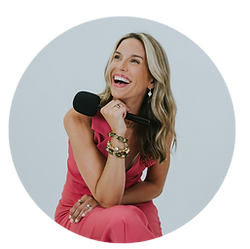


Beyond Fear: Cultivating Courage for a Brave New You with Mary Poffenroth, Ph.D.
When was the last time your shoulders crept up to your ears for no reason you could name, or your jaw locked tight in a meeting you can't even remember the topic of? That's not random. My guest this week, Dr. Mary Poffenroth, has spent her whole career studying that exact moment, and she says most of us have never even learned to say the actual word for it: fear.
Dr. Mary was adopted at birth and became the first person in her family to go to college. Early in her science career she worked in the astrobiology unit at NASA, then pivoted to studying fear and courage full time and became a biology lecturer at San Jose State University. She's spoken at TEDx London and Harvard, her work has been featured in Time and Forbes, and her book, Brave New You, came out in October 2024. Erica got it on a Friday and had finished the whole thing by Monday's recording.
So what's a neurohack? It's a fast, in the moment tool for short circuiting a fear spiral using your physiology or your psychology, quietly enough that no one around you notices. Dr. Mary has built 25 of them into a free card deck, organized under her RAIN method: recognize the physical tell your body gives you, assign one name to the emotion, identify whether it's rooted in a fear of not being enough or a fear of losing control, then navigate it with a neurohack, like pressing firmly on the meaty part of your palm to trigger your vagus nerve and tell your nervous system you're safe.
That skill is in short supply at work right now. A 2026 Radical Candor survey found 6 in 10 employees stay silent rather than voice a dissenting opinion, and Kim Scott, the company's co-founder, says people are afraid to tell the truth in this moment. That's fear showing up in exactly the place Dr. Mary says we clock it least: mid-meeting, mid-sentence, choosing the safe answer over the true one.
The 2025 Lean In and McKinsey Women in the Workplace report found 80% of women want to be promoted to the next level, compared to 86% of men, and the gap widens further at both the entry and senior levels. Dr. Mary would call a lot of that a fear of not being enough, dressed up as caution. She's not asking you to get rid of fear. She's asking you to practice courage like a muscle, five squats today instead of none, one small step past the invisible line around your comfort zone. That's the whole conversation: not a cure for fear, a way to work with it.
TRANSCRIPT:
Erica: Hey, girl. By now, you know I have Her Collective, my online community for ambitious women who are done doing it alone. Her Collective is for the women who are smart, capable, and driven, but they find themselves stuck on the sticky floors like self doubt, burnout, and waiting for permission that quite honestly never comes. Inside HER, you get more than motivation. You get real support, real strategies, and real momentum.
Erica: We work on things like clarifying what you want now and what's coming next, building confidence without burning yourself out, navigating hard conversations, career moves, and leadership moments with clarity, and surrounding yourself with women who actually get it. This isn't about hustling harder. It's about moving intentionally with the right tools and the right people in your corner. If you're ready to stop spinning, start choosing yourself, and build a career in life that actually feels aligned, I'd love to welcome you inside her collective. You can learn more and join us at www.joinhercollective.com.
Erica: Because honestly, girl, you were never meant to do this alone. Welcome to the Glass Ceiling and Sticky Floor podcast, the podcast where we get real about the challenges women face in work, life, and leadership. I'm your host, Erica Rooney, HR executive, keynote speaker, and executive coach, and I'm on a mission to get more women into positions of power and keep them there. This is the space where we call it the paradoxes, being told to lean in but not too far, to speak up but not too loudly, To be ambitious, but not that ambitious. Does it sound familiar?
Erica: We're over all that. Here, we break down the sticky floors that keep us stuck from imposter syndrome and perfectionism to burnout and fear, and give you real strategies to shatter those glass ceilings once and for all. So if you're ready to rewrite the rules, own your power, and take your career and life to the next level, you're in the right place. Today's guest is a groundbreaking scientist, captivating speaker, and a leading expert on courage and innovation. Doctor Mary Poffenroth is a scientist, a fear and courage researcher, and a biology lecturer at San Jose State University.
Erica: From being adopted at birth to being the first and only member of her family to attend college to her first day at NASA and beyond, y'all, Mary has dedicated her life to understanding how to best do the scary things. So, oh, y'all know this is gonna be good. But her book, Brave New You, Strategies, Tools, and Neurohacks to Live More Courageously Everyday came out in October 2024. And y'all, it is a page turner. Doctor Mary has spoken on stages like TEDx, London, and Harvard, and her work has been featured in Times and Forbes.
Erica: And she is here to help us make courageous leaps forward. Doctor Mary, welcome to the show. How are you?
Dr. Mary: Thank you so much, Erica. I'm fantastic, and such a warm welcome. I really appreciate it. Love your energy on this Monday morning, here on the West Coast. So
Erica: Yes. Well, oh, my goodness. West Coast. So we are early for you, but I've gotta tell everybody who's listening, like, y'all know I read a lot. And Mary so kindly and generously shipped me her new book, Brave New You.
Erica: And I got it on Friday. And as she just said, it's Monday. We're recording now. I finished it. I literally finished it in the weekend.
Erica: It is a fantastic read. It's an easy read. But I love it because if y'all are fans of, you know, this podcast and what we talk about here, y'all are gonna really love this discussion because she's an expert in fear and courage. So I've gotta start, Mary, with how did you even get started on studying courage and fear?
Dr. Mary: Yeah. Well, you know, I was raised in the household and many of our origin stories are gonna always start with us as kids, right? Because we don't get to really choose our pathway as children. It's foisted upon us and we, as adults, get to kind of choose how to make up or reparent the things that, we didn't get the first time around. So for me, I was raised in a household where big happy emotions were totally fine, like bubbly joy, like oh those yummy sticky good ones, those were totally fine but any darker emotions, any emotions like fear or anger or shame absolutely were not allowed, Ever.
Dr. Mary: If you're gonna do it, go hide in a corner. Mama didn't wanna see it. And as an adult, that let me not be able to really express the full spectrum of the human experience. And being a scientist, I'm like, I'm gonna go study it because I don't know how to feel all of the emotions. So why not study it?
Dr. Mary: That's more safe for me. And really why I got into science in the first place is because traditional science is a great place to be unemotional. You are taught to be unemotional. You are required to be unemotional. Everyone around you has self selected to also be unemotional about things.
Dr. Mary: And it's wonderful until you kind of wake up one day, I'm not living my whole life. I'm not living the full human experience. And that's really when I started to dive deeper into studying fear, courage. How do we balance that? Not necessarily always just let's get rid of fear because it's gross and dirty.
Dr. Mary: It's no. It's just part of the natural human experience, but how do we manage it? How do we use it to our advantage? And that we can live more courageous lives and do bigger stuff and go, you know, those exotic adventurous places that we think that we can't figuratively or literally go into. And that's kind of, you know, how I started my journey on the science side and then really wanted to make sure that I was living the stuff I was speaking about in keynotes and workshops and, you know, writing about.
Dr. Mary: So I try to make it not just preach from the stage and then go hide in my bed cave, but do you know, like like, I'm putting the neurohacks that we'll talk about a little bit later. I put those into action action because I think that that's the best, most authentic way that I can connect to my audience is try it and see if it works for me. And I mean, I love to hear when it works for them as well.
Erica: I love it. And what I loved about your book is you talk about the different types of fear and the different types of courage. And I think while my brain knows that that makes sense that there's different types, I've never really thought that through. So do me a favor and walk me through all of the types of fears. And really, you kind of put that into three tiers, the biological, the cultural, and the personal.
Dr. Mary: Yeah. And it's kind of like when we think about all the fears that humans can experience, it is a huge spectrum. And even if we say exactly one thing, I usually start everyone on the things that are easier to talk about like clowns. Are you afraid of clowns and spiders? You know, before we start digging into are you afraid of not being enough?
Dr. Mary: Are you afraid of losing control over your autonomy? But usually you start people out with the funny stuff and even though Well, it's small. Yeah. Something a little jovial because I do try to make all of my, whether it's a talk or a workshop or a live event as fun as possible even though many people will see fear and courage as a topic that's unfun by its very nature. Right?
Dr. Mary: People are so afraid of the f word, like actually saying the word fear. It's hilarious. We'll use all kinds of other words to not say I'm afraid.
Erica: 100%. 100%.
Dr. Mary: So many words. Right? And so, let's just take clowns. Some people clowns are cute. I love them.
Dr. Mary: Great. Some people might be in the middle. I'm like, give or take. Don't really care. But a lot of people have this huge deep seated terror of clowns, and it's gonna be on that spectrum.
Dr. Mary: And the way that we all individually interact with that is gonna have a lot about who we were, what we were told about clowns, how our, family group and the people that are closest to us talk about clowns, and how we perceive that future of clowns. Right? Obviously, I'm oversimplifying things. So if you want to look at the biological, biological fears are really stemming from things that are kind of like hardwired. Right?
Dr. Mary: When you think about why we use dark or night in almost every scary movie is because we don't see well at night. Naturally, we see better in the day. We're a diurnal species. We don't hunt at night. We, like, just aren't very good at protecting ourselves or our loved ones at night.
Dr. Mary: And so night is scary. It's biologically scary. It's baked into how we have survived this far. Now you look at something like, move back to clowns, that may have been you got scared in your family unit as a young child because you had an older brother that thought it was super funny to torture you with clowns, would leave them underneath the bed, do something crazy. Right?
Dr. Mary: So those are those stories you're telling yourself and that your, you know, small kind of like society told you about clowns. It doesn't necessarily mean they're true, but these are the stories you repeat over and over in your head. And then if you kind of like pull it out even more like a a greater society around all the things that we tell each other to be afraid of. And these are the stories that we most likely heard from, you know, the time that we started to kind of pay attention to media, pay attention to what other people were saying in books and magazines and newspapers. And those fears can last and be really, you know, at scale.
Dr. Mary: There's the fears that we kind of create with each other, going back to the example of your brother making you afraid of clowns just because he thought it was funny. You know, it's not really impacting the global trend on fear of clowns. But people in power and people in power cannot necessarily just be leaders in economic and business, but people that have the ability to talk to other people. So, you know, our modern influencers, they have power. The people that have the ability to take their viewpoints and spread them far and wide can very easily shape what many, many people, maybe thousands, maybe millions, maybe billions of people are afraid of, whether or not those are really valid fears or not.
Dr. Mary: And when we look at what kind of fears we individually want to kind of work on and get stronger, you know, we definitely work on the biology fears, but I'm really all about ROI. Like, okay. What fears in your life are the biggest ones causing you not to have the life you want? What are the ones that are giving you the most grief that you are not taking that meeting? You are not asking for that promotion.
Dr. Mary: You are not going after that master's degree because you're too old and everyone's gonna be younger than you. What are those types of fears? Those are the ones that you really wanna work on, especially using my work. And just letting it go on things that don't really impact your life. Like, clowns, you know, is it really impacting your life?
Dr. Mary: Just let it go. It's fine. You can still be afraid of clowns. Just don't watch clown movies and don't have clowns in your house. Don't go to circuses.
Dr. Mary: Done. Like you don't have to get rid of everyone.
Erica: We can avoid the clowns but we cannot avoid some of those other fears, which really go in that personal section, which is the fear of failure. But maybe even as you said, the fear of success, which I know is something I think a lot of us are getting used to. And then, of course, the fear of change. So many people fear that. But you also talk about rejection and loneliness and uncertainty, judgment or criticism, abandonment.
Erica: Right? All of those. And I love it, Mary, because this is where, like, your work and my work intersect. Because in my world, we all call those sticky floors. Right?
Dr. Mary: And those are
Erica: the things that keep you stuck. The limiting beliefs, maybe toxic behaviors. But I love your work because you really encourage people to experiment, and you do this through a neurohack or neurohacking, which I love because biohacking is all the rage.
Dr. Mary: So tell me, what is a neurohack? And then maybe, like, give us one really great example. Yes. So because I'm coming from science, I've spent decades in science. Experimentation is always about moving the needle forward.
Dr. Mary: And when you think about experimentation, it means not every experiment is going to work out. That's the best premise that before we start this, don't assume that because it didn't work out for you that the whole thing is broken or you did something wrong. Like, information is information. Data is data. Whether it's positive, neutral, or negative, it's still information that allows you to go on.
Dr. Mary: So, within our RAIN method, and I'm not sure we have enough time to do the full RAIN method, but, I do want to share with your audience, all of the, the RAIN method infographic, a bunch of neurohacking resources are all free for, no sign in, no sign up for your audience at hello,bravenewyou.com because my last name is hard to spell. It doesn't take you to a page where you can download these things. You can have them on your phone. You can return back to them because I'm a visual person. I like to return back to things that I hear to get like a refresh.
Dr. Mary: So all these things are gonna be there. And again, no sign up. So, you know, within the RAIN method, which is gonna take a little bit longer to kind of like go over, and we've touched a little bit on it, if you wanted to just cut to like the interchangeable neurohacks of stage four, which is navigate, I have this great little deck. We actually have 25 total in the deck right now. I have three just in front of me And these neurohacks are some of them are tapping into your physical biology, your in your physiology.
Dr. Mary: Some of them are tapping into the psychology of fear, but all of them are trying to, in the moment, kinda short circuit that fear spiral. Right? So you're able to regain calm, recenter, regain control, and most of them can be done with no one knowing what you're doing. This is my favorite because when we're in high stress situations, you can't just take a little nap on the floor right before
Erica: you go and do
Dr. Mary: a presentation. Right? That could be nice, but you may already be on stage. So what do you do when everyone is waiting for you to take, you know, take the step forward and say something amazing? One of my favorite ones is called Pinch the Valley.
Dr. Mary: This will be in the deck at Hello, Brave New You. And super, super simple. This is going to activate your vagus nerve, through your hands. I start, because I'm right handed, I start with my right to my left. It doesn't matter.
Dr. Mary: You can switch it up, start left to right. But But essentially, I'm going to describe it using my dominant hand. So with my non dominant hand, I make an l, like, from the l, like, you know, in the nineties. And then, the area you wanna kinda target is not the webbing here. It's the meaty bit in between the thumb and the forefinger.
Dr. Mary: So you're gonna take your right thumb and forefinger and kinda pinch in that left meaty bit in between the left thumb and forefinger with your right hand. And just, like, firm, not hard. Don't like dig in and leave a a bruise. But, you know, like, some firm pressure, just above that webbing. And what you're doing is you are telling your, you know, like, your system, your vagus nerve, you're activating your vagus nerve to help your system understand that you're safe.
Dr. Mary: Now for me, I feel this instantly. This is one of my favorite go tos. That if I'm in a high stress situation, before I go on stage to do a keynote, before I walk into, you know, work with, like, tech and creative organizations, before I'm gonna do a workshop for them, this is my go to. And you just I'm just holding my hands. No one knows you're doing it.
Dr. Mary: Right? And you can come back to this anytime. And, you know, you're in the middle. You're like, I can't go out and do, like, you know, deep breathing in the bathroom because I'm in this meeting. I have to stay.
Dr. Mary: This you could do this on the table. You can do it in traffic. I mean, this is one of my favorites. Now it doesn't mean it's going to absolutely be everyone's favorite. And that's why I have so many that you can kind of pick and choose and have and I love cards.
Dr. Mary: Also, why they're in card form so that you can have the ones that really work for you in your literal back pocket, you know, at your desk, like in your bag to kind of remind you before you go into something stressful or you're feeling it, all the ways that you are already empowered. You are ready because you have these tools in your back pocket that if you get into that room and you're feeling like, oh God, I can't do this. Why am I here? They should have had somebody better. Oh my God.
Dr. Mary: Oh my God. Grab one of those tools to make your way through that fear storm.
Erica: Amazing. I love it. And what I wanna do is I wanna ask you about the different types of courage because I think that's super interesting how you frame that. And then we can go into the RAIN method, which for spoiler alert, for y'all listening and who are familiar with the snap, it's similar but different. So you're gonna wanna listen so you can hear that through.
Erica: But this was what I found so interesting. You you talk about the many different types of courage and you list physical courage, moral courage, social courage, intellectual courage, emotional courage, and my most favorite, existential courage. And we do not have time to go into all of those. So I would love for you to talk about moral courage if you can and then also the existential courage because I think a lot of the women who listen to this podcast find themselves stuck in these moral courage dilemmas. So expand on moral courage if you can, and then we'll talk about existential.
Erica: Hey there, listeners. If you have ever felt like you're stuck in a place, held back by self doubt, perfectionism, or that pesky inner critic, you're not alone. We all face those sticky floors that keep us from reaching the heights we dream of. But guess what? It's time to shatter those limiting beliefs and toxic behaviors to uncover infinite possibilities.
Erica: My book, Glassy Leads and Sticky Floors, is your ultimate guide to smashing through barriers, overcoming limiting beliefs, and stepping into your full potential. This book has been endorsed by none other than the great Mel Robbins, best selling author and motivational powerhouse. It's also been featured in Success Magazine, so you know it's packed with insights that work. Inside, you'll find real life sticky floor stories, practical strategies to help you navigate your own sticky floor moments, and a whole lot of inspiration to keep you climbing. This isn't just a book.
Erica: It's your road map to success, confidence, and freedom. Grab your copy of Glass Ceilings and Sticky Floors today at www.ericaandersonrooney.com. Whether you're in the boardroom, the classroom, or just starting out, this book is for you because no one, and I mean no one, deserves to stay stuck, no one deserves to feel small, and you have glass ceilings to shatter. Let's do this.
Dr. Mary: Sure. So I'm going to come to those two, but just for listeners that haven't read the book, I'm just going to start at the most kind of basic one, then we can work up to those two. So the most basic one, and this is the one that most people think about with courage is gonna be that physical courage. Right? That is the World War II movie with the hero running into the battle and like shooting and bombing and saving the day.
Dr. Mary: I got you. Like that's that is one act of physical courage, right? And the reason why there's different kind of courageous is because we're very complex species. We know that. And there's different ways that we can all show up in our lives and be courageous.
Dr. Mary: And then there's parts of our lives that we are very timid and withdrawn and are not courageous. So one of the reasons why I included that in the book is so that we can kind of start to take an inventory. Like, where in that list are you like, oh, dude, I am braveheart all up in that intellectual courage. Like, that's me. And then if you look at maybe the other ones of, let's say, moral courage, you're like, oh, I could maybe I could maybe focus a little bit more on that because I I don't really show up for myself or my community or my family in a way that I would want to, but I haven't really thought about it.
Dr. Mary: Right? Because if you don't think about it, if you don't pay attention to it, nothing changes. And so for moral courage, and I'm gonna keep this very general because morality, there's a shared morality of right and wrong. Like murder bad, okay, that we're all, you know, as a society, as a functioning society, but then we have caveats on, well, is this, that, and the other murder still bad? Right?
Dr. Mary: And then you get into the philosophy of it. So the unique individual must decide where is your moral compass. So we're not gonna get into that part. We'll say you're gonna decide for you personally where your moral compass is. But then how courageous do you live with that moral compass?
Dr. Mary: Are you showing up every day defending your North Star saying, here is what I believe is right and wrong. I will stand up at the cost of maybe friends, maybe my job, maybe my personal safety to protect what I truly believe is the right thing to do that makes us a moral individual and a moral community. So that would be like moral courage. I love the word existential because I feel we've been using the words existential crisis for the last five years. Absolutely.
Dr. Mary: Life, that, and unprecedented. Like, unprecedented existential crisis. That'll be the name of my next book.
Erica: It's just I love it. No. I did as soon as I saw this piece, and you put that in your book of, like, we all talk about it, an existential existential dread crisis, but we don't talk about the existential courage. And you basically say that this is the courage of regularly choosing the least familiar path instead of taking the well trodden one. And I was like, oh, that hits deep.
Erica: And that's just because question there. It was just the fabulousness of the definition.
Dr. Mary: I love it. Yeah. No. And that's just the thing. It that courage is a practice.
Dr. Mary: And just like when we put the time and effort to make our bodies physically healthy, if we're choosing to run or lift weights or dance or do whatever I mean, we're keeping our stretch, tai chi, we're trying to make a discerned effort to stay physically healthy. And if we don't, then our body deteriorates, it gets weaker, you have less ability to feel strong, less ability to lift things that are heavy because you have to do it as a practice and encourages that way as well. It's easy to continue to fall into, Oh my God, I'm overwhelmed. I have no power to change anything in my life or the world. I'm just gonna go into the blanket cave and put on Netflix for about nine hours and then pass out and just rinse and repeat.
Dr. Mary: Because our brains, like the ancient part of our brains, wants us to stay safe at any cost. Right? But it's our more modern brain, the prefrontal cortex that is there to plan and create and dream. That part of our brain knows that we have to make different choices if we are truly going to have the life that we say that we want. And if we do just a little bit of practice every day, like doing five squats a day is so much better than doing no squat today.
Dr. Mary: Now working out for a full hour, even better. But sometimes, some days, you just got five squats in you. That's fine. Just punch at least those
Erica: five squats. Five squats in. Do the little thing. Yes.
Dr. Mary: Right? Yeah. And it it's the same thing as the practice of existential courage when it just becomes your your norm, your go to, then the the stuff that you used to find really hard to do, to send that cold pitch, you know, ask somebody for help. If you keep doing it, it stops being so hard and then you can do harder stuff. You know, I always come back with the same when you were physically training for something.
Dr. Mary: If you just started running, you're not gonna be able to run 26 miles. That's not how that works. But you start running, you know, half a mile. Hey, nothing wrong with starting with a half a mile and then you go like three quarters of a mile. And so courage is much like that and we have so many opportunities to act courageous in our daily lives.
Dr. Mary: Like so many when we start to look for it. Right? And that's We really do.
Erica: We really do when we start to look at it. And one thing that I found to be really helpful with me when I find myself acting from a a place of fear because I know that growth happens outside my comfort zone. So I always envision myself standing almost like with this dotted line around me in a hemisphere, right, that says, you know, like, comfort zone, and I just take one little baby step out. Like, I'm not taking a leap. I'm not running 20 miles.
Erica: I'm just taking one little baby step out. Little toe. And but all of those add up. But I really wanna talk about your RAIN method, which stands for recognize, assign, identify, and navigate because this was your framework to really deal with fear. So I would love pick any example or any story from your life, Mary, that maybe you can share and walk us through the RAIN method so that our listeners can kind of get this idea and start to put it into practice in their everyday lives.
Dr. Mary: Sure. Yeah. And, since I am gonna go kind of fast through the steps, but just so we keep on time, just wanna remember remind that this whole info card that I'm holding up is available to download for free at hellobravenewyou.com. So, you know, starting with just kind of bifurcating the highest level of our fears, our fears can be categorized into like either a fictional fear or a non fictional fear. So a non fictional fear is something that's happening right in that moment.
Dr. Mary: It's a shared fear of the people around you. And a fictional fear may have a kernel of truth, just like really good fiction books do, but it's not necessarily something that is happening right then. It's either happening in the before or the after. Right? This is where we call it a lot of worries.
Dr. Mary: And knowing that can, you know, is that really that first step as we make our way into recognize. So the story I'm going to use, it was easier to recognize, but sometimes, like, you can't recognize that you're in a fear arousal. And also we just call fear arousal stress as a way to, again, remove the need to say the f word. And so, like, one of my tells, if it's not as extreme as the story I'm gonna start with, is I'm a shoulder scruncher, like my shoulders will be by my ears. I'm a gla, like gla, a jaw clencher.
Dr. Mary: But for you, anyone listening, it could be, oh, I get, you know, tummy upset or I get sweaty palms or there's many, many different tells, some of them on here, but there's some physiological reaction that your body's literally trying to tell you, hey, we're starting to ramp up our amygdala, which is our fear center, is starting to get fired up, something's happening so that we can get curious and move on to our next stage of sign. But before this, I'm gonna give the example, and this story is actually in the book. And, I was in Croatia and, with a couple of friends, we were doing what's called Yacht Week. And Yacht Week sounds way bougier than what we're doing, but it's like a bunch of different yachts, but that could mean it's just, you know, synonymous for boat. So some people have the super yachts, and then we were on, like, a sailing yacht with, like, 10 people that had also helped sail the boat.
Dr. Mary: So it was it was a small boat. So it's all it it's moored off the where we were on this little island in the Adriatic. We had to take, like, a water taxi to get there. There was not supposed to be any storms. It was summer looking good.
Dr. Mary: All of a sudden, the sky, like, opens up, a cyclone comes through, and we don't have anywhere to stay on this tiny island. There's no hotels. It's, like, Delugene. I mean, there's already feet of water on, like, all of the little streets of this tiny, tiny island. And we're trying to figure out the taxis aren't going back to the boats because it's, you know, a cyclone just came in.
Dr. Mary: It's nighttime. We're only in, like, little club club and outfits. And so and we're just like, okay. Well, now we do. At that point, it was both physical fear because we had no place to stay and the kind of fictional fear of what would happen if we did stay.
Dr. Mary: Where would we stay? Are we going to be hurt by people? What is that, you know, like all the different scenarios that are going through my mind at the time. And, you know, at that, if I, you know, like at that time using this for a sign, I know this is going to be very small on the card, but there's also a downloadable of just the fear wheel. And giving it a name, a single name.
Dr. Mary: Many people will fight me on this and they're like, no, I feel like more than one. I'm like, I get you, boo. But the point is to pigeonhole. You just get one. You just gotta get one.
Dr. Mary: So you choose one. And you know, at that time, I was terrified because of all of the unknowns and I felt helpless and out of control because I was in another country that I didn't speak the language. Actual weather, like serious weather was coming in and we had nowhere to go or how to get back to our boat. And, you know, in that moment, the next stage identify is helpful of, again, just choosing one of these buckets. So when we look at all of our fears in a very general way, we can put them into the fictional fears into one of two buckets.
Dr. Mary: Either the fear of not enough or fear of losing control. Now again, some people are like, well, some of my fears are so complex, it's a little of both. And that's true. But in terms of having this method help you calm and regain power, you just wanna pick one bucket because that's gonna be the power of pigeonholing for your brain. It allows your brain to feel that it has control even if the system or the individual experience feels totally out of control.
Dr. Mary: Right? It's returning that power back to you. So if I had to choose one in that moment, then I would say, you know, fear of losing control, losing the control to go back to my bed, losing control to get off of this island. Like, I felt, you know, I felt both trapped and very exposed. And then fourth is gonna be navigate.
Dr. Mary: On the RAIN card, there is box breathing that many people that have gone on a wellness journey are familiar with box breathing. Navy SEALs it, it's amazing. But on this fourth step, we can trade out any of the neurohacks, like the ones that I showed with Pinch the Valley, the Near and the Far. All of these are individually kind of like Lego pieces that you can trade for that fourth step and be able to use what your favorite neurohack is. So as we close, instead of doing the breathing one, which will take a little bit longer, I'll do this one that's very quick.
Dr. Mary: So the near and the far let me get that in camera. Something easy, you can use a pen, you can just use your finger. It is better if you have glasses on to take them off, and you just put, like, one finger in front of your face, kind of like not all the way out, but not all in.
Erica: But your index finger just straight up.
Dr. Mary: Yeah. Your index finger. I mean, you could be naughty and do any, like, you know, your middle finger if you're really feeling it. But, yeah. For me, I just use my index finger.
Dr. Mary: And then, slowly, you know, I kind of, like, focus nothing. Like, you wanna, like, hyperfocus on the finger so much that it kinda blurs. And then just slowly bring your finger to your nose and, like, kind of trying to cross your eyes, the thing your mom told you not to do when you're a kid because it would stay that way. And then touch your nose. And then still trying to make it one finger and, like, really trying to, like, force your eyes to get it to one finger.
Dr. Mary: And then once it goes to one finger, which for me is right about there, then extending it all the way out doing the same thing until you are out of arm length and then doing the exact same thing. So what you're gonna have, this is convergence and divergence of your eye. This is gonna help reset that fear spiral. And happens in the moment. You could, you know, keep doing it till you feel better.
Dr. Mary: Something that you have a pen or your finger on you when you're out and about. And the key is to do it slowly and really force your eyes to focus on that finger and let it come in and out of focus. Right? Let it become like two and one and two and one. Cut because that's helping to reset that fear response.
Erica: Amazing. So just to simplify it, it's recognized. So look for those physical sensations, the racing heart, maybe the dry mouth, or who knows what, digestive issues. Then you need to go to the emotion wheel, which is all about assigning a name to that emotion, whether you are feeling rejected, abandoned, you can work your way out, then you must identify it, which is choosing between is this the fear of being not enough or the fear of losing control? And then you navigate it by using an amazing neurohack like the one you just shared.
Erica: That is Yeah. It's easy to remember. It's free for everybody. It is stunning, and it really will help. What I will implore on you, though, my friends who are listening, is to remember that this is not a one and done fix.
Erica: It never is. This is a rinse and repeat. You're gonna have to do it all the time. New level, new devil. We're always gonna have these kind of things.
Erica: But, doctor Mary, what would be, like, your one piece of advice if someone is really feeling stuck? They really feel like they lead more from a place of fear and courage rather than from what fills their bucket. What would that piece of advice be for them?
Dr. Mary: Play. Like, get back to play, which is why, you know, like, I created the neurohacks. They're all in the book, but I wanted to make a card deck because cards are playful and they're bite size. Right? Like, take just one card.
Dr. Mary: Like, sometimes even the book can feel, like, too much if you are in a huge amount of overwhelm. You look at a a full book and you're like, even though my book is full of stories, it's not like a textbook. It's like, I don't know if I can handle a whole book, but you absolutely can handle just one card. And all these cards are stand alones. Right?
Dr. Mary: If you can tell yourself, I'm gonna play around with just one just one card. And when that works for you, you feel empowered. And even if you don't wanna play with something that is, you know, a, like, self development thing, just play anything. We have lost the art of play, especially in the last five years, that we feel that we're not being productive if we're playing or playing has to have an outcome or, you know, play without profit. It's just play, even if it's It's not fun.
Dr. Mary: It's just like it. Right? Yeah. And that helps enormously to start to rebuild those courage muscles because, I myself included, there are seasons of my life that I am way more courageous than others. Like it's even when you get to just like physical fitness, like sometimes you're a triathlete, sometimes you're sitting on the couch and the most exercise you get is going to the mailbox.
Dr. Mary: But it's, you know, it's that constant desire to practice to get back to that triathlete level. And and to know that you got there once, you can get there again.
Erica: Yes. Just play a little bit. Just play around a little bit. Well, doctor Mary, thank you so much for spending your time here with us, your expertise. Y'all get out there and go buy Brave New You by doctor Mary Poffenroth.
Erica: It really is a great book. You're gonna read it real quick. And listen, if today's conversation lit a fire under you, here is your next move. Don't keep it to yourself. Make sure that you share this episode with a friend.
Erica: Drop a review. They really are super important, and let's keep this conversation going. Remember that your potential is limitless, and the only thing standing in your way are those sticky floors. But guess what? You have the power to break through them.
Erica: So go out there, take up space, and let's shatter some ceilings together.
RESOURCES MENTIONED IN THIS EPISODE:
- Ready to close your own sticky floors and get real support in your corner? Join HER Collective, Erica's community for women in corporate America.
- Never miss an episode. Follow Glass Ceilings & Sticky Floors on Apple Podcasts.
- Grab Erica's book, The AI Gap, and start closing the gap for yourself.
- Brave New You by Dr. Mary Poffenroth, Ph.D., her book on strategies, tools, and neurohacks for living more courageously.
- Download the free RAIN method info card and 25 neurohacks, no sign up required, at Hello Brave New You.
- Follow Dr. Mary Poffenroth on Instagram.
- Learn more about her research and speaking at marypoffenroth.com.
RELATED EPISODES:
FREQUENTLY ASKED QUESTIONS:
What is the RAIN method for managing fear?
The RAIN method is Dr. Mary Poffenroth's four step framework for working through fear in real time. You recognize the physical tell your body gives you, assign a single name to the emotion, identify whether it's rooted in a fear of not being enough or a fear of losing control, then navigate it with a neurohack. The full method and a free card deck are available at Hello Brave New You.
What is a neurohack?
A neurohack is a fast, in the moment tool that interrupts a fear spiral using your physiology or psychology, without anyone around you noticing. One example is Pinch the Valley, where you press firmly on the meaty area between your thumb and forefinger to activate your vagus nerve and signal safety to your nervous system. Dr. Mary has built 25 of these into a free card deck.
What is existential courage?
Existential courage is Dr. Mary Poffenroth's term for the practice of regularly choosing the least familiar path instead of the well worn one. It's one of six types of courage she outlines in her book Brave New You, alongside physical, moral, social, intellectual, and emotional courage. Like physical fitness, she says it has to be practiced consistently or it weakens.
MORE FROM ME
Follow me on Instagram @ericaandersonrooney and @joinhercollective
SUBSCRIBE & REVIEW
If you loved this episode, please take a moment to subscribe and leave a review on Apple Podcasts. Your support helps us reach more women who need these insights. Thank you for tuning in to the Glass Ceilings and Sticky Floor podcast. See you next week!
Hi, I'm Erica!
In the last 15 years, I climbed to Chief People Officer, 6x'd my income, walked away from a culture that stopped matching my values, wrote two books, and built HER Collective to help thousands of women rise to power and lead in the age of AI. I've learned a thing or two about smashing ceilings and closing gaps, and Glass Ceilings & Sticky Floors is where I open the playbook, the receipts, and the real stories to share it all with you.
_JPG.jpg)